
What Carjacking Actually Looks Like: Stages and Locations
Carjacking is the theft of a motor vehicle directly from its driver or occupants through force, violence, or intimidation—often at gunpoint. Unlike simple auto theft, carjacking involves a violent confrontation where the perpetrator forcibly removes the driver from the vehicle, sometimes extracting wallets, phones, and other valuables simultaneously. Understanding the anatomy of a carjacking attack helps drivers recognize warning signs and respond appropriately.
Carjackers employ several distinct attack patterns, each exploiting specific vulnerabilities. The most common method is the "bump and rob," where a carjacker intentionally rear-ends your vehicle in traffic. When you exit to assess damage and exchange information, the attacker jumps into your unlocked car and drives away. A second tactic involves staged accidents, where criminals simulate an injury or vehicle problem to lure good Samaritans out of their cars. The "ruse" technique uses a following vehicle flashing lights or waving to suggest a mechanical problem with your car, prompting you to pull over into an isolated area. The "trap" method involves surveillance—criminals follow victims home and block their driveway as they pull in, timing their approach for maximum vulnerability.
Timing and location are critical factors in carjacking risk. According to FBI motor vehicle theft data from 2024, the vast majority of carjackings occur during late-night hours, with peak incidents between 8 PM and 4 AM. High-vulnerability locations include automated teller machines (ATMs), self-serve gas stations and car washes, shopping mall and grocery store parking lots, highway entry and exit ramps, parking garages for public transit, residential driveways and streets as people enter or exit vehicles, intersections controlled by traffic lights or stop signs, and congested traffic areas where vehicles must stop or move slowly. These locations share a common factor: they place drivers in stationary or slow-moving positions where carjackers can approach on foot with minimal detection.
Key Statistics: Where, When, and How Often Carjackings Happen
Carjacking data presents a complex picture of recent crime trends. From 2019 to 2023, the FBI recorded steady increases in motor vehicle theft overall, with the nationwide rate rising from 199.4 incidents per 100,000 people to 283.5 incidents per 100,000. However, carjacking specifically—a subcategory of robbery involving forced vehicle theft—showed volatility. Between 2022 and 2023, carjacking rates declined from 7.5 to 6.6 per 100,000 people, a measurable improvement. More recent data from the first half of 2025 shows carjacking declined by 24% compared to the same period in 2024, suggesting sustained downward momentum in major cities.
City | 2023 Rate (per 100,000) | 2024-2025 Trend | Key Notes |
|---|---|---|---|
Washington, DC | Highest national rate | ↓ 48% (2023–2024) | Fell from 959 incidents (2023) to under 500 (2024) |
Baltimore | Second highest | ↓ Significant decline | Among top 5 cities with highest carjacking rates |
Memphis, TN | Third highest | Elevated but declining | Concentrated in specific neighborhoods |
Chicago | High volume | ↓ 24% (2024–2025) | Under 1,000 for first time since pandemic (2024: 957) |
Denver | Top 5 cities | Moderate decline | Less volatile than East Coast cities |
Geographic concentration is pronounced. Five cities account for a disproportionate share of the nation's carjackings: Washington, DC; Baltimore; Memphis, Tennessee; Chicago; and Denver. Cook County, Illinois (Chicago area) represented 76% of all motor vehicle thefts in Illinois in 2023. Within cities, carjackings cluster in specific neighborhoods. In San Francisco, the South of Market neighborhood experienced carjacking rate increases of more than 100% from 2020–2021 to 2022–2023, highlighting how risk varies dramatically by block and time.
Carjacking Method | Frequency | Victim Response Outcome | Prevention Difficulty |
|---|---|---|---|
"Bump and Rob" | Most common | High success if victim exits vehicle | Medium—awareness helps |
Staged accident/Good Samaritan | Common | High success if victim stops | Medium—vigilance essential |
"Ruse" (waving to signal problem) | Moderate | Medium success; depends on isolation | Medium—trust instincts |
Direct confrontation at stop | Moderate | High success; victim often complies | Low—unavoidable at stops |
Residential driveway/trap | Less frequent but severe | Very high success; victim isolated | High—location disadvantage |
Carjackings predominantly target standard automobiles (78.1% of all motor vehicle thefts from 2019–2023), followed by trucks (12.2%) and other vehicles (8.0%). FBI data through 2023 shows that juveniles account for a growing proportion of offenders, with youth carjacking rates increasing in 2022 and 2023 even as adult offender rates declined. This demographic shift has important implications for prevention strategy: younger offenders may be less experienced with forceful confrontation but potentially more unpredictable.
Prevention: Route Planning, Timing Awareness, and Situational Vigilance
The most effective carjacking prevention combines advance planning, environmental awareness, and behavioral discipline. These measures work not by creating an impenetrable barrier but by making your vehicle an unattractive target relative to alternatives, thereby shifting criminal attention elsewhere.
Route and Timing Strategy
Plan your route before departure, prioritizing well-lit, frequently-traveled surface streets and highways over isolated back roads. Avoid driving alone, especially at night; carjackers prefer isolated targets. Keep your vehicle well-maintained with a full gas tank—a breakdown forces you to stop in potentially dangerous locations. If you must stop at an ATM, gas station, or shopping center, position yourself near the entrance under lighting and surveillance. When driving through congested areas or stopped in traffic, leave at least half your vehicle's length between your car and the vehicle ahead—this provides escape room if you sense immediate danger. Drive in center lanes when possible; this makes it harder for carjackers to approach from the side.
Vehicle and Environmental Awareness
Before approaching your parked car, scan the surrounding area for loitering individuals, suspicious vehicles, or anything that "feels off." Approach your vehicle with your key already in hand, ready to unlock and enter promptly. Check the back seat, floor, and hatch before entering. Lock all doors immediately upon entry and keep windows rolled up, even for short trips in seemingly safe neighborhoods. This simple discipline eliminates the most common carjacking vulnerability: doors unlocked while the vehicle is occupied.
While driving, maintain awareness of vehicles behind and beside you. If you suspect you're being followed, do not drive home or to a secluded location. Instead, drive directly to a police station, fire station, busy public area, or open business. If a vehicle bumps you from behind, do not exit immediately—this is a classic "bump and rob" setup. Instead, turn on your hazard lights, call 911, and drive slowly to a safe, well-populated location (a police station is ideal) before pulling over to exchange information. If someone waves you down or signals a problem with your vehicle, remain skeptical. Drive to a safe location to assess the situation. If a minor accident occurs, roll up your windows, lock your doors, and proceed only when you feel confident.
Parking Discipline
Park in well-lit areas near sidewalks and pedestrian traffic. Avoid parking near dumpsters, dense woods, large vans or trucks that obscure your vehicle from view, or anything that limits sightlines. In parking lots, choose spaces visible from the building entrance or security office. If using a parking garage, park on lower levels closer to exits and near the security office. Never leave your car running unattended—this is both illegal in many jurisdictions and an open invitation to carjackers. Never leave valuables in plain sight, even if your car is locked; put items in the trunk or take them with you.
Trust Your Instincts
If a situation makes you uncomfortable—an unfamiliar person approaching, someone loitering near your vehicle, a request that feels off—trust that feeling and remove yourself from the situation. Carjackers often telegraph their intentions through body language, hesitation, or presence in unusual contexts. Your instinctive discomfort is an early warning system refined by evolution and experience.
What to Do During a Carjacking Attempt: Prioritize Your Life
If you find yourself facing an active carjacking, law enforcement guidance is unequivocal: your life is worth more than any vehicle. The objective during an attack is survival and escape, not vehicle recovery. Resistance should be your last resort and only if you are confident you can safely overcome the threat.
Immediate Response
If a carjacker threatens you with a gun or other weapon, comply with their demands. Do not argue, negotiate, or attempt to reason with the attacker. Give up the vehicle immediately. Get away from the area as quickly as possible—exit the car and move to safety. Your physical distance from the attacker is your primary protection.
Make no quick or sudden movements that could be misinterpreted as resistance or a counter-attack. Keep your hands visible at all times. Speak calmly and clearly. If children are present in the vehicle, inform the carjacker immediately—many attackers focus only on the driver and may be unaware of additional occupants. This awareness can affect their decision-making and reduce harm to vulnerable passengers.
Information Gathering
While prioritizing escape, attempt to observe and remember details about the carjacker and any accomplices: height, weight, race, sex, age, distinctive features (scars, tattoos, facial hair), build (slender, muscular, large), complexion, clothing, and any weapons visible. Observe the carjacker's vehicle if a second vehicle is involved—note color, make, model, year, license plate, distinguishing marks (scratches, dents, decals, custom wheels), and direction of travel. However, follow the golden rule for descriptions: only report details you absolutely remember. If you are uncertain, do not guess—inaccurate descriptions can misdirect police investigation.
After the Incident
Contact police immediately once you reach safety. Call 911 or your local law enforcement non-emergency line. Provide dispatch with your location and the direction the carjacker traveled. Report all observed details about the perpetrator and vehicle. Many stolen vehicles are recovered because victims provide timely, accurate information to police. Additionally, stolen vehicles are frequently used to commit other serious crimes—bank robberies, assaults, murders—so your report contributes to broader public safety.
Do not accept any contact from the carjacker or accomplices claiming to offer the vehicle back for money, ransom, or "business arrangements." This is extortion and a felony. Report any such contact to police immediately. Document the incident for insurance purposes: retain the police report number, take photographs of any injuries, and notify your insurance company promptly.
How Vehicle Specification Changes the Outcome: Glass, Locks, and Mobility
While behavioral prevention remains the primary defense against carjacking, vehicle engineering introduces a secondary layer of protection. Certain specifications—protective glass, advanced locking systems, and run-flat tire technology—measurably alter carjacking success rates by increasing the attacker's effort, delay, and detection risk.
Ballistic Glass and Window Security
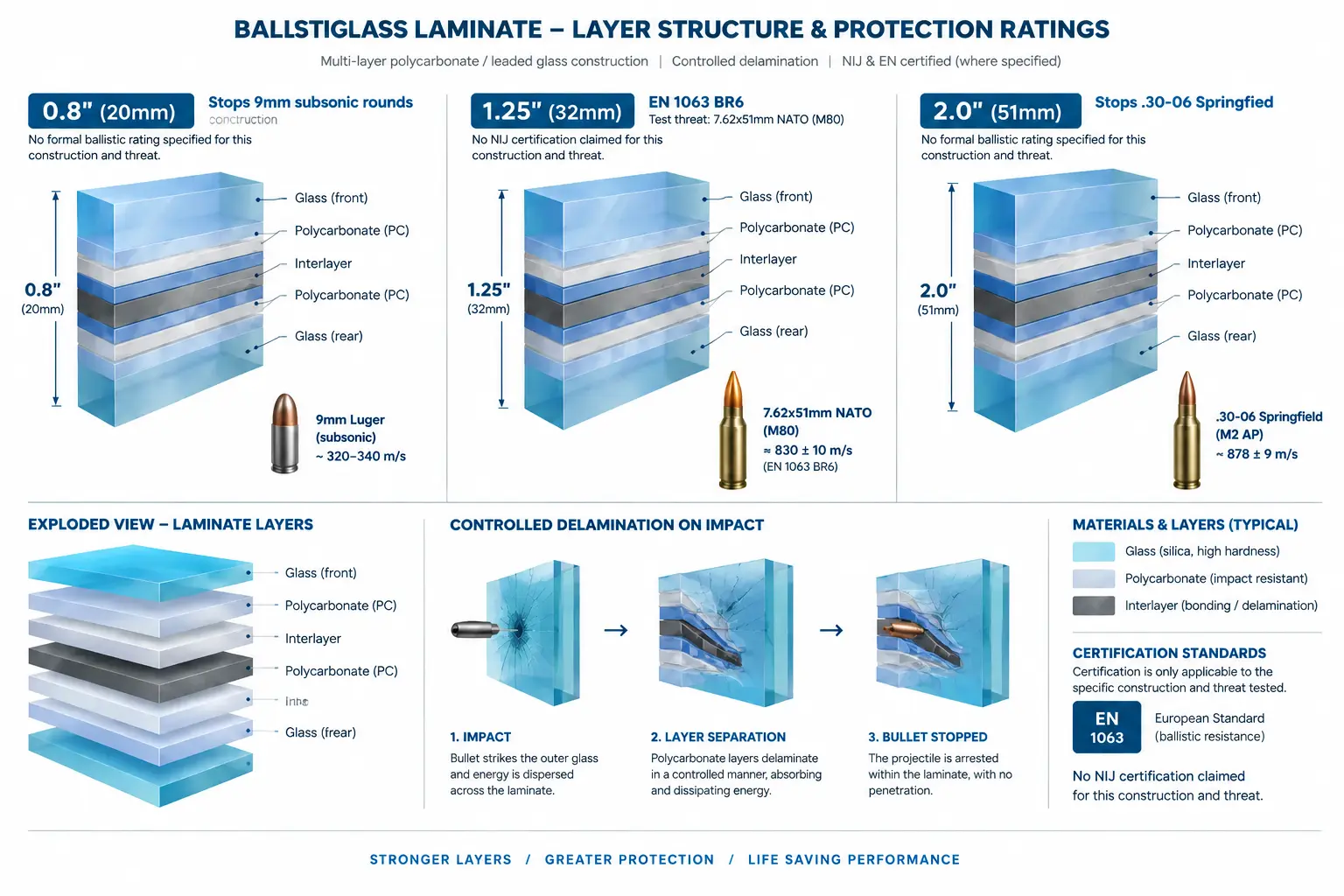
Standard automotive glass is designed to shatter on impact, protecting occupants from laceration. Ballistic glass (called "transparent armor" in the security industry) is engineered for the opposite purpose: it absorbs and disperses ballistic energy rather than fragmenting. Traditional ballistic glass consists of layers of polycarbonate and leaded glass laminated together with interlayers designed to achieve controlled delamination upon impact—the material absorbs projectile energy by separating in controlled layers rather than shattering catastrophically.
The thickness and composition of protective glass directly correlate with the level of threat it defeats. A 0.8-inch thickness stops subsonic rounds from 9mm handguns. A 1.25-inch thickness defeats 7.62×51mm NATO rifle rounds. A 2.0-inch thickness stops high-powered .30-06 rifle fire.
For carjacking scenarios specifically, the protective benefit is less about stopping bullets and more about creating a barrier that is psychologically intimidating to attackers and mechanically difficult to breach. A carjacker attempting to smash a window encounters resistance that extends the confrontation, increases noise and attention from bystanders, and signals that the target vehicle is defended. In armored vehicle projects managed by security specialists, ballistic glass installation delays window breach by 15–45 seconds depending on threat level—a critical interval that allows occupants to accelerate and escape.
Standard laminated automotive glass offers minimal protection against determined attacks. Protective glass, by contrast, resists impact, gunfire, and tool-assisted breach attempts. The disadvantage is weight and cost; protective glass can add 200–400 pounds to a vehicle depending on coverage area and threat level, affecting fuel economy and requiring suspension upgrades.
Advanced Door Locks and Electronic Controls
Vehicle locks exist in a security hierarchy. Standard OEM (original equipment manufacturer) locks on civilian vehicles are designed to prevent accidental opening, not to resist deliberate attack. A skilled carjacker can force or pick a standard lock in seconds.
Advanced locking systems for armored or high-security vehicles employ several technologies. Electronic immobilizers, now standard in most modern vehicles manufactured since the late 1990s, prevent engine starting without the correct key or fob. This technology was central to reducing vehicle theft overall—when electronic immobilizers became widespread across vehicle fleets (adoption varied by nation but accelerated after EU mandates in 1998), vehicle theft rates dropped approximately 40% within nations as the pool of vulnerable vehicles shrank.
For carjacking specifically, reinforced door locks combined with electronic controls create friction. Mechanical reinforcement includes heavy-duty latches, reinforced door frames, and multi-point locking systems. Electronic augmentation adds keyless entry systems that cannot be defeated by relay attacks (which intercept fob signals). Some systems lock automatically when the vehicle reaches a certain speed, preventing carjackers from exiting with child passengers. Others can lock doors remotely, trapping an occupant inside.
However, locks alone do not prevent carjacking at gunpoint. A carjacker with a weapon can force a driver to unlock the vehicle or provide keys. The protective value of advanced locks is most relevant in attempted carjackings where the attacker lacks a weapon or where delay allows escape: a driver who cannot be coerced into unlocking the door has time to accelerate away or attracts the attention of bystanders and responding police.
Run-Flat Tires and Mobility Preservation
Standard pneumatic tires lose functionality immediately upon puncture or deflation, immobilizing the vehicle. This vulnerability is catastrophic in carjacking scenarios—a victim attempting to escape could be incapacitated by gunfire to the tires, forcing abandonment of the vehicle.
Run-flat tire technology uses a reinforced sidewall or an internal polymer ring that provides support if the tire loses pressure. The most common automotive implementation is a solid polymer ring (sometimes called a "donut" or "roller") clamped around the wheel's centerline, inside the standard tire. If the pneumatic tire is punctured or deflated, the polymer ring contacts the rim and provides structural support. This allows the vehicle to continue at speeds up to 60 mph for distances exceeding 60 miles—sufficient to reach a safe location or police assistance.
The military and law enforcement have employed run-flat systems for decades; civilian protective vehicle programs (armored vehicles for VIPs, cash transport, etc.) adopted run-flat technology beginning in the 1990s. Field data from protective vehicle operators shows that run-flat systems restore mobility in approximately 80–90% of tire-damage scenarios, allowing occupants to escape areas of active threat.
The trade-off is ride comfort—run-flat systems provide less shock absorption than standard pneumatic tires, resulting in a stiffer ride. Cost is also elevated; run-flat tire installations for full vehicle coverage (all four wheels) range from $2,000 to $5,000 for civilian applications.
Vehicle Specification | Carjacking Protection Mechanism | Effectiveness Against Gunpoint Threat | Effectiveness Against Tool/Force Attack | Cost Impact | Practical Application |
|---|---|---|---|---|---|
Ballistic Glass (BR4–BR6 rating) | Delays/prevents window breach; psychological deterrent | Low—can be overcome with time and effort | High—resists cutting, prying, impact | High ($3,000–$15,000+) | High-threat environments only |
Advanced Electronic Locks | Prevents unauthorized door operation; buyer time for escape | Low—gunpoint can coerce unlock | Medium—delays attackers; requires specialist tools | Medium ($500–$2,000) | Moderate-threat environments |
Run-Flat Tires | Preserves mobility after tire damage; enables escape | High—allows escape after tire gunfire | High—maintains escape capability | Medium ($2,000–$5,000) | All vehicle security profiles |
Reinforced Door Hinges & Frames | Resists forced entry; delays breach | Low—gunpoint bypasses mechanical delay | High—greatly extends time-to-entry | Medium ($1,000–$3,000) | Moderate-threat environments |
Immobilizer + Kill Switch | Prevents engine start without authorization | Low—gunpoint coerces compliance | High—prevents hot-wiring; forces carjacker away | Low ($40–$500) | All vehicle security profiles |
Layered Protection Philosophy
In our experience working with protective vehicle implementations across diverse threat environments, the most resilient configurations combine multiple layers. A vehicle with ballistic glass alone is still vulnerable to gunpoint coercion if the driver is outside the vehicle or if tire damage occurs. A vehicle with run-flat tires and immobilizers but standard glass is vulnerable to window breach and theft if the driver abandons it. The most effective configurations integrate electronic immobilizers (to prevent hot-wiring even if the carjacker acquires the vehicle), run-flat tires (to enable escape after tire damage), reinforced locks (to delay forced entry), and visibility-grade ballistic glass on at least the windshield and driver-side window (to create psychological and mechanical barriers during confrontation).
For civilian drivers in moderate-threat areas, the most practical upgrade is run-flat tire technology combined with verifying that the vehicle's electronic immobilizer is functioning—a feature that adds minimal cost and addresses both "carjacker uses vehicle after theft" and "escape during armed attempt" scenarios.
FAQ: Defending Yourself, Deterrents, and Geographic Risk
Q: How should I physically defend myself if a carjacker approaches?
A: Physical resistance is not recommended unless you are confident you can safely overcome the threat and escape. If the carjacker is armed, compliance is the safest option. If the carjacker is unarmed and you are trained in defensive techniques or self-defense, you have more discretion—but any physical confrontation carries risk of injury. The priority is escape: if you can safely run to a populated area or police station, do so. If you are already inside your vehicle, locking the doors and accelerating away is more effective than physical confrontation. If you are outside your vehicle, creating distance between yourself and the carjacker while moving toward populated areas or calling for help is the superior strategy.
Q: What is the most effective carjacking deterrent?
A: The most effective deterrent is unpredictability. Carjackers target vehicles they observe for extended periods or situations they can predict. Varying your routine—different departure times, different routes, occasionally driving with a companion—makes you a less attractive target. Visible security measures (alarm decals, steering wheel locks, visible immobilizers) act as secondary deterrents by signaling that your vehicle requires extra effort. Ultimately, however, behavioral awareness—maintaining situational consciousness, trusting your instincts, and avoiding isolated or vulnerable positions—is the most reliable deterrent. Carjackers seek easy targets; if you present as alert and aware, they will typically move on to someone else.
Q: Which states or cities have the highest carjacking risk?
A: According to FBI data and city-level crime reports, carjacking is heavily concentrated in urban areas with specific geographic clusters. Washington, DC has the highest carjacking rate per 100,000 residents of any major U.S. city. Baltimore, Maryland ranks second. Memphis, Tennessee ranks third. Chicago, Illinois has the highest absolute number of carjackings due to its size, with over 1,800 incidents at the peak (2022) and ongoing cases in the hundreds. Denver, Colorado rounds out the top five. However, recent data shows significant declines in most major cities—Chicago fell from 1,849 incidents (2022) to 957 (2024), a 48% reduction. If you live in or travel through these cities, heightened awareness and adherence to prevention practices are warranted. Carjackings also occur in smaller cities and mid-size metros, but at lower rates. Rural areas experience carjacking at minimal rates.
Q: What time of day is carjacking most likely?
A: The vast majority of carjackings occur during late-night hours, with peak incidents between 8 PM and 4 AM. This temporal pattern reflects carjacker preference for darkness (reduced visibility for identification), reduced police patrol intensity in some areas, and lower pedestrian activity (fewer witnesses). However, carjackings occur at all hours; daytime incidents are less common but not rare, particularly in high-crime areas or during rush-hour traffic congestion. If you must travel during late-night hours, employ additional precautions: avoid isolated routes, drive with doors locked and windows up, vary your routine, and maintain heightened awareness.
Q: Should I install a visible alarm system or steering wheel lock as a deterrent?
A: Yes, visible security measures have measurable deterrent value. Steering wheel locks, alarm system decals, and other visible devices signal to potential carjackers that your vehicle has protective features. Research on vehicle theft prevention shows that visible deterrents are effective not because they are technically impossible to defeat, but because carjackers are opportunistic and will move on to easier targets. A visible steering wheel lock may take 30–60 seconds to remove, but in that interval the carjacker has lost the element of surprise and faces increased detection risk. Combined with behavioral awareness, visible deterrents reduce your relative attractiveness as a target. They are inexpensive ($25–$200 for steering wheel locks and alarm system decals) and therefore worth installing.
Q: If I'm carjacked, should I report it to police even if the vehicle is recovered?
A: Absolutely. Reporting carjacking accomplishes several goals: it contributes to official crime statistics that help police allocate resources; it creates a record that may assist in identifying serial carjackers or organized theft rings; it preserves evidence if the vehicle is recovered and the carjacker is apprehended; and it documents the incident for insurance purposes. Additionally, stolen vehicles are frequently used to commit other serious crimes—armed robbery, assault, murder—so your report to police can prevent harm to others. Report the carjacking as soon as safely possible, provide all observed details about the carjacker and accomplices, and cooperate fully with police investigation.
Q: What should I do if I notice someone following me home?
A: Do not lead the follower to your home or any location where you will be isolated. Instead, drive directly to the nearest police station or fire station. If no public safety building is immediately available, drive to a busy, well-lit commercial area (24-hour convenience store, gas station, shopping center) and go inside where staff and other customers can assist. Call 911 en route and provide dispatch with your location and the follower's vehicle description. If the follower approaches your vehicle, keep doors locked, windows up, and drive away if possible. Once in a public area with witnesses and staff present, exit the vehicle and seek help. Do not exit your vehicle in an isolated location.
Q: Are keyless entry cars more vulnerable to carjacking?
A: Keyless entry cars are vulnerable to relay attacks—a method where thieves intercept the signal from your key fob to unlock and start the vehicle remotely. However, relay attacks are distinct from carjacking; they occur when the vehicle is unattended. For carjacking specifically, keyless entry does not substantially increase vulnerability compared to traditional keyed entry. A carjacker confronting a driver will coerce them into unlocking the vehicle or handing over the fob regardless of whether the system is keyless or traditional. To protect against relay attacks on keyless entry systems, store your fob in a signal-blocking pouch (Faraday bag) when not in use, and verify that your vehicle's doors are locked before you walk away by testing the door handle manually rather than relying solely on the key fob signal.
Sources / References
Bureau of Investigation (FBI). "FBI Releases Motor Vehicle Theft, 2019–2023," August 12, 2024. Uniform Crime Reporting Program data on motor vehicle theft and carjacking rates, 2019–2023.
Council on Criminal Justice. "Crime Trends in U.S. Cities: Mid-Year 2025 Update," July 23, 2025. Analysis of crime data from 42 major U.S. cities, including carjacking rates and year-over-year trends through June 2025.
Council on Criminal Justice. "Trends in Carjacking: What You Need to Know," December 13, 2024. Geographic breakdown of carjacking incidents by city and neighborhood, including San Francisco South of Market analysis.
asher, Jeff. "Vehicle-Based Crime Plunged in 2024," January 27, 2025. Analysis of carjacking data from 22 U.S. cities showing 27% overall decline in 2024.
California Highway Patrol. "Are You Vulnerable to a Carjacker?" Prevention guidance and response tactics for carjacking situations.
Essex County Prosecutor's Office. "F.A.Q. – Carjacking." Legal definitions and victim response protocols.
Illinois Vehicle Hijacking and Motor Vehicle Theft Prevention and Insurance Verification Council. "2024 Annual Report," 2024. State-level carjacking data for Illinois, Cook County analysis, and task force activity.
Metropolitan Police Department, Washington D.C. "Carjacking." Prevention and response guidance from the jurisdiction with the highest U.S. carjacking rate.
INTERPOL. "Advice for Car Owners." International carjacking prevention guidance.
National Highway Traffic Safety Administration (NHTSA). "Anti-Theft Devices." Technical specifications and effectiveness of vehicle security devices.
ASU Center for Problem-Oriented Policing. "Carjacking Summary." Evidence-based response strategies and effectiveness research.
Triple-I (Insurance Information Institute). "Facts + Statistics: Auto Theft." National motor vehicle theft data and state rankings.