
When gunfire erupts around your vehicle, your survival depends on understanding three critical principles: recognizing the threat, making split-second decisions, and executing the right response for your specific situation. This guide provides actionable information based on law enforcement guidance and emergency response protocols to help you protect yourself and your passengers.
Understanding the Threat: When and Where Shootings Occur
Vehicle shootings happen in two primary contexts: random incidents and targeted confrontations. According to law enforcement research, drive-by shootings account for approximately 10% of homicides in major metropolitan areas, with data from 1993‑2020 showing an estimated 63,882 emergency department visits due to drive-by shooting injuries across the United States.
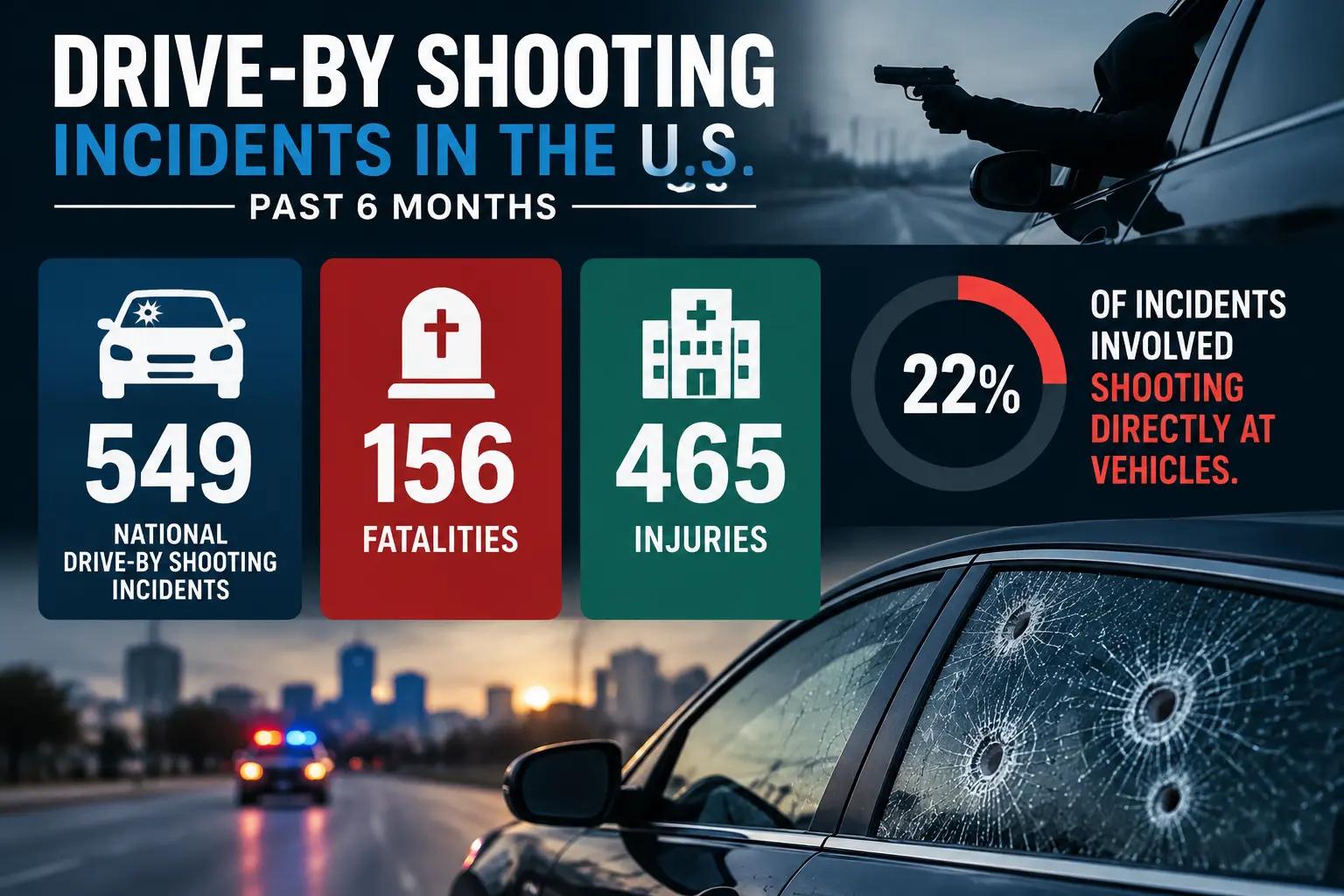
The threat profile matters. In a six-month period, 549 drive-by incidents were reported nationally, claiming 156 lives and injuring 465 people. Notably, 22% of these incidents involved shooting at vehicles directly, and victims in vehicles face a higher risk of head and neck injuries compared to pedestrian shooting victims.
Road rage represents a separate category of vehicle shooting risk. The National Highway Traffic Safety Administration defines road rage as "assault with a motor vehicle or other dangerous weapon by the operator or passenger(s) of one motor vehicle on the operator or passenger(s) of another motor vehicle," and research shows 11% of drivers engaged in violent behaviors in the previous year, including shooting incidents.
Your Immediate Response: The RUN, HIDE, FIGHT Protocol
Law enforcement agencies, including the Transportation Security Administration and California Office of Emergency Services, recommend a three-tier response framework:
RUN: Escape If Possible
If gunfire erupts and escape is feasible, prioritize leaving the area immediately.
- Use your vehicle as a tool: The gas pedal is your primary defense. If your car is operational and traffic permits, accelerate away from the threat. Driving rapidly away from the shooter presents a harder target and maximizes distance.
- Abandon the vehicle if trapped: If gridlock, a crash, or disabled engine prevents escape, exit the vehicle decisively. Open the door, keeping it pinned open with your foot to prevent it from rebounding, and move to cover.
- Leave belongings behind: Do not spend seconds retrieving items. This delay could be fatal.
- Signal your intentions: Keep your hands visible as you exit. This prevents law enforcement from misidentifying you as a threat when they arrive.
- Prevent others from entering danger: If safe, warn nearby people not to approach the area where shots are being fired.
HIDE: Take Cover If Escape Isn't Possible
When evacuation isn't feasible—due to traffic, injury, or the shooter's proximity—concealment and cover become critical.
Understanding the difference: Most vehicles provide minimal ballistic protection. Windows, doors, and body panels are thin metal that conceal your position but do not reliably stop bullets. Only three points offer genuine cover:
- The engine block (front of vehicle)
- The front axle (lower front suspension)
- The rear axle (lower rear suspension)
Positioning yourself:
- Crouch or lie behind the engine block if the threat approaches from ahead or the sides.
- Move toward the rear axle if the shooter is in front of you.
- The farther you are from the vehicle, the wider the protective buffer. Move back several feet from the axle rather than hugging it directly.
- Do not remain upright or partially exposed near windows or doors.
Minimizing detection:
- Silence your phone (disable vibrate as well as sound).
- Remain quiet and still. Active shooters typically spend 10‑15 minutes in an area; staying undetected significantly improves survival odds.
- Avoid predictable movements. If you must look out from cover, do so quickly and from varying positions rather than repeatedly appearing in the same spot.
FIGHT: Incapacitate the Threat as Last Resort
Only when your life is in imminent danger and escape or hiding are impossible should you attempt to disrupt the attacker. This is the highest-risk option and should only be pursued if you are trained and confident in your ability to act.
- Act decisively and aggressively without hesitation.
- Use any available object as a weapon (vehicle keys, flashlight, fire extinguisher, rocks, etc.).
- Yell and create noise to distract and disorient the attacker.
- Move toward the threat rather than away‑hesitation or half-measures increase your risk.
This option requires situational judgment that only you can make in the moment.
Road Rage Situations: De-escalation and Avoidance
Road rage shootings often stem from heated confrontations that escalate over minutes, not seconds. Prevention and de-escalation are your best defenses.
Prevent Escalation
- Don't engage: Avoid eye contact, hand gestures, or verbal responses to aggressive drivers. Research shows that aggressive driving culture—the prevalence of aggressive behavior in your area—is the strongest predictor of high engagement in aggressive driving.
- Create distance: If another driver is tailgating, speeding up to challenge you, or exhibiting hostile behavior, change lanes, reduce speed gradually (don't brake abruptly), or take an alternate route.
- Manage your own driving: Allow extra travel time, listen to calming music, and maintain a comfortable vehicle environment. Stress and time pressure increase the likelihood that both you and other drivers will escalate conflict.
If You're Being Followed or Confronted
- Do not drive home: Leading an aggressive driver to your residence puts your family at risk. Instead, drive to a public location—police station, hospital, fire station, or busy commercial area.
- Use your horn and stay locked inside: If someone approaches your vehicle, use your horn to attract attention and stay inside with doors locked and windows closed.
- Call 911 immediately: Provide the dispatcher with your location, the vehicle description, license plate (if visible), and the direction of travel.
- Keep distance for escape: When parked, position your vehicle so you can exit quickly without being boxed in.
Handling Law Enforcement Arrival
When police arrive at an active shooting scene, officers prioritize stopping the threat. Your actions during this phase are critical to your survival.
- Remain calm and follow all instructions: Officers may be moving rapidly, using forceful language, or deploying less-lethal agents like pepper spray or tear gas.
- Put down any objects you're holding: Drop phones, bags, jackets—anything that could be misidentified as a weapon.
- Raise your hands with fingers spread and avoid sudden movements: Keep your hands visible and move deliberately.
- Do not point, scream excessively, or make quick gestures toward officers: These actions may cause officers to perceive you as a secondary threat.
- Provide information once safe: When it's safe to do so, tell officers:
- The shooter's last known location
- Number of shooters and their physical descriptions
- Type and number of weapons (if you observed them)
- Number of victims or injured people
- Direction the shooter was traveling
- Stay in place: Officers will likely hold you at an assembly point until the scene is secure and all witnesses are identified. Do not leave until law enforcement instructs you to do so.
Vehicle Hardening and Preparation
While ballistic armor is beyond the scope of everyday vehicle protection, practical measures can improve your odds: Test Results & Reports
- Maintain mechanical reliability: A vehicle that starts and runs reliably is your best defense—it lets you escape.
- Keep doors locked and windows up when stationary: This slows unauthorized entry and limits shooter access.
- Maintain situational awareness: Notice vehicles or individuals acting suspiciously, unusual traffic patterns, or confrontational behavior before it escalates.
- Plan routes in advance: Knowing alternate roads reduces time spent in congested areas or high-risk zones.
- Keep your phone charged: A dead battery eliminates your ability to call for help.
FAQ
Q: Is my car door bulletproof? A: No. Standard vehicle doors are made of thin steel and do not reliably stop bullets. Only the engine block, front axle, and rear axle provide meaningful ballistic cover. Use doors for concealment (hiding your position) but not as protective cover if shots are fired.
Q: If I'm hit in a vehicle during a shooting, should I try to drive away? A: If you are conscious and the vehicle is drivable, yes—leaving the area reduces your exposure to additional shots. If the vehicle is disabled or you are unable to drive due to injury, exit and move to cover as described in this guide. Call 911 as soon as it is safe to do so.
Q: What should I tell my family about vehicle shootings? A: Teach them the RUN, HIDE, FIGHT framework. Explain that if gunfire erupts, the goal is to create distance from the threat (run), find cover if running isn't possible (hide), and only as a last resort attempt to stop the threat (fight). Emphasize that survival is the priority, not possessions or pride.
Q: If someone is road raging at me and appears to have a weapon, what do I do? A: Do not engage. Drive immediately to a police station, hospital, or busy public location. Stay inside your locked vehicle and call 911. Provide dispatch with your location and a description of the other vehicle. Do not drive home. This removes the threat from your immediate vicinity and ensures police will locate you rather than the aggressor.
Q: How do I know if a situation is about to escalate to violence? A: Watch for repeated aggressive maneuvers (tailgating, cutting off, blocking your lane), aggressive horn use or headlight flashing, the other driver pulling alongside you repeatedly, or signs of a weapon. If you notice any of these, create distance immediately and do not respond to provocations.
Q: Should I keep a weapon in my vehicle? A: This is a personal decision that depends on your training, local laws, and comfort level. A weapon you are untrained to use under stress is more likely to escalate a situation or be used against you than to help. If you choose to carry a weapon, professional training is essential. This guide does not provide firearms guidance and recommends consulting a qualified self-defense instructor.
Q: What's the difference between "cover" and "concealment"? A: Concealment hides you from view but doesn't stop bullets (e.g., a vehicle door). Cover both hides you and protects you from bullets (e.g., the engine block). In a shooting, prioritize cover. If only concealment is available, use it—detection is still a serious risk, but bullets through thin materials are a worse one.
Sources / References
Securing Transportation Assets & Operations: Mitigation Strategies for Highway Modes – TSA (2014)
Vehicle Ramming Action Guide – CISA (2024)
Using Your Car for Cover: BSR's Training for Vehicle Defense – NRA (2018)
Cal OES Active Shooter Awareness Guidance (2016)
Drive-By Shootings: Problem Guide – U.S. Department of Justice (2008)
First-Ever National State-by-State Study of Drive-By Shootings – Violence Policy Center (2007)
Road Rage – Washington State Department of Licensing
Aggressive Driving and Road Rage Technical Report – AAA (2025)
How to Avoid and Manage Road Rage – Utah State University Extension (2024)
Aggressive Driving – AAA Exchange