
Start From the Threat: Understanding Your Real Risk
Vehicle protection is not one-size-fits-all. The right defense depends entirely on what you're actually protecting against. A driver in a high-crime urban neighborhood faces different threats than someone parking in a suburban lot or driving through a rural area. NHTSA data from 2025 shows a vehicle is stolen every 48 seconds in the United States, yet theft rates vary dramatically by location, vehicle type, and criminal tactic. Understanding the specific threat allows you to invest wisely rather than over-armoring against unlikely scenarios or under-protecting against real vulnerabilities.
Vehicle threats exist on a spectrum. At the lowest end: opportunistic theft from vehicles (smash-and-grab), where criminals target unattended cars with visible valuables. At the middle: vehicle theft where carjackers or organized theft rings steal the vehicle itself, often through forced entry or carjacking. At the highest end: ballistic threats directed at occupants, where criminals target the vehicle because of who is inside, see Vehicle Shooting Protection: What to Do If Your Car Is Shot At. Each threat demands different solutions. A steering wheel lock addresses opportunistic theft. Ballistic glass addresses gunfire. Run-flat tires address tire-puncture escape scenarios. The layered approach means combining defenses that work against multiple threats simultaneously, rather than choosing a single silver bullet.
In our experience working with vehicle protection across high-crime and moderate-crime environments, we've observed that drivers who succeed in preventing theft or carjacking do so by understanding their specific threat environment and matching their investments accordingly. Drivers in neighborhoods with high theft-of-vehicle rates but low carjacking rates benefit most from immobilizers, alarms, and visible deterrents. Drivers in areas with organized carjacking activity or high-risk professions (cash handlers, executives in unstable regions) benefit from hardened glass, reinforced locks, and run-flat systems. Drivers who combine behavioral discipline—locking doors, parking in lit areas, removing valuables—with hardware matching their threat profile experience measurably lower victimization rates.
Deterrence vs. Protection: Two Different Problems Requiring Different Solutions
This distinction is critical and often misunderstood. Deterrence makes your vehicle a less attractive target relative to others. Protection means your vehicle resists breach even if attacked. They are not the same, and they do not always require the same hardware.
Deterrence operates on the criminal's decision-making process. A thief evaluates several targets and steals from the one offering the lowest effort-to-reward ratio. Research from the National Insurance Crime Bureau (NICB) and criminological studies confirm that the majority of vehicle thefts and break-ins are crimes of opportunity—criminals choose easier targets when easier targets exist. Visible deterrents (steering wheel locks, alarm decals, visible cameras) signal that your vehicle requires extra effort. This doesn't make theft impossible; it makes theft less rewarding than the car next to yours. A study on nudge-based theft prevention found that behavioral messaging in high-crime neighborhoods reduced thefts from insecure vehicles by a significant margin, suggesting that making people think carefully about vehicle security has measurable protective effects.
Protection, by contrast, is about mechanical and ballistic resistance. If a thief is determined to breach your vehicle—whether for the vehicle itself, forced entry to steal from it, or worse—protection involves materials and systems that delay, resist, or defeat the breach attempt. This includes security film (which holds glass fragments together), ballistic glass (which resists penetration), reinforced locks, and run-flat tires (which preserve mobility after tire damage).
The critical insight: deterrence is cheap and works well against opportunistic crime. Protection is expensive and works well against determined crime. Mixing them strategically is the practical approach for most drivers.
Threat Profile | Primary Defense Layer | Secondary Defense | Tertiary Defense | Appropriate for |
|---|---|---|---|---|
Opportunistic theft from vehicle | Visible deterrent (lock, alarm decal, steering wheel lock) | Layer 2: Audible alarm or CCTV camera | Immobilizer + locked doors | Urban lot, retail parking |
Organized vehicle theft (theft of vehicle) | Immobilizer + kill switch | Tracking device (GPS/ALPR recovery) | Visible deterrent | High-theft neighborhoods |
High-crime area (mixed threats) | Layered: parking discipline + immobilizer + visible deterrent + alarm | Run-flat tires for escape capability | Security film on side windows | High-crime urban areas |
Carjacking or ballistic threat | Ballistic glass (BR4–BR6) + run-flat tires | Reinforced locks + electronic controls | Immobilizer | Executive protection, cash transport |
Moderate-crime suburban area | Parking discipline + immobilizer | Visible steering wheel lock | Alarm system (optional) | Suburban neighborhoods |
Glass: Security Film vs. Laminated Ballistic Glass—Different Threat Levels, Different Solutions
This comparison generates more confusion than any other vehicle security topic. The reason: "ballistic film" is a marketing term that obscures a technical reality. There is no film that stops bullets. There are films that improve fragment retention and delay breach, and there is ballistic glass that is engineered to stop projectiles. They solve different problems.
Security Film: Fragment Retention and Delay
Security window film (also called safety film or anti-shatter film) is a laminate typically made of polyester (PET) with a pressure-sensitive acrylic adhesive. When applied to the interior surface of standard automotive glass, the film bonds to the glass and holds fragments together if the glass breaks. The result: instead of shattering into projectiles, the glass fractures but remains in place, held together by the film.
According to research from the Motor Industry Repair Research Centre (Thatcham), security films can provide between 20 and 90 seconds of resistance to manual attack, depending on film thickness and application method. A 14-mil film (approximately the thickness of a credit card) will typically delay forced entry 20–30 seconds. Thicker films (20–30 mil) can extend this to 40–90 seconds. For context, research on vehicle crime shows that a 10-second delay is sufficient to deter most opportunistic thieves, because the noise, visibility, and effort required trigger them to abandon the attempt.
The critical limitation: security film does not stop bullets. Industry authorities, including the International Window Film Association (IWFA) and European Window Film Association (EWFA), explicitly state that "bullet resistant" window films do not exist as standalone products. Films can be part of a tested ballistic system (glass + film + frame), but the film alone does not provide ballistic protection. If a firearm is discharged at a window covered with security film, the bullet will penetrate the film and glass. The film may slow the projectile marginally and prevent glass from scattering, but it will not stop the round.
For high-crime areas where the primary threat is break-and-grab or forced entry (not gunfire), security film is cost-effective: installation typically ranges from $300–$800 per vehicle depending on coverage area. The trade-off is aesthetic—multiple applications can cause optical distortion, scratching (especially as windows are opened/closed), and reduced light transmission.
Ballistic Glass: Projectile Resistance by Design
Ballistic glass is engineered as a complete system from the foundation. Standard automotive glass is tempered glass designed to shatter safely. Ballistic glass is laminated glass composed of multiple layers (typically glass laminated with polycarbonate or acrylic interlayers) designed to absorb and disperse ballistic energy. When five stacked standard Toyota Hilux side windows were subjected to AK-47 fire, all five were penetrated without difficulty, but protective ballistic glass of equivalent thickness from the same vehicle platform would resist the same threat.
Ballistic glass effectiveness is rated by threat level according to international standards: EN 1063 (European), UL 752 (United States), NIJ (US law enforcement), and others. BR4 stops most handgun rounds (9mm, .45 ACP). BR5 stops rifle rounds (7.62×39mm, 5.56mm NATO). BR6 stops high-powered rifle fire (7.62×51mm NATO, .30-06). In protective vehicle projects, ballistic glass can be retrofitted to OEM vehicles using laminate systems that work in conjunction with existing glass to achieve UL Level 1 protection (handgun defense) on standard ¼-inch automotive glass.
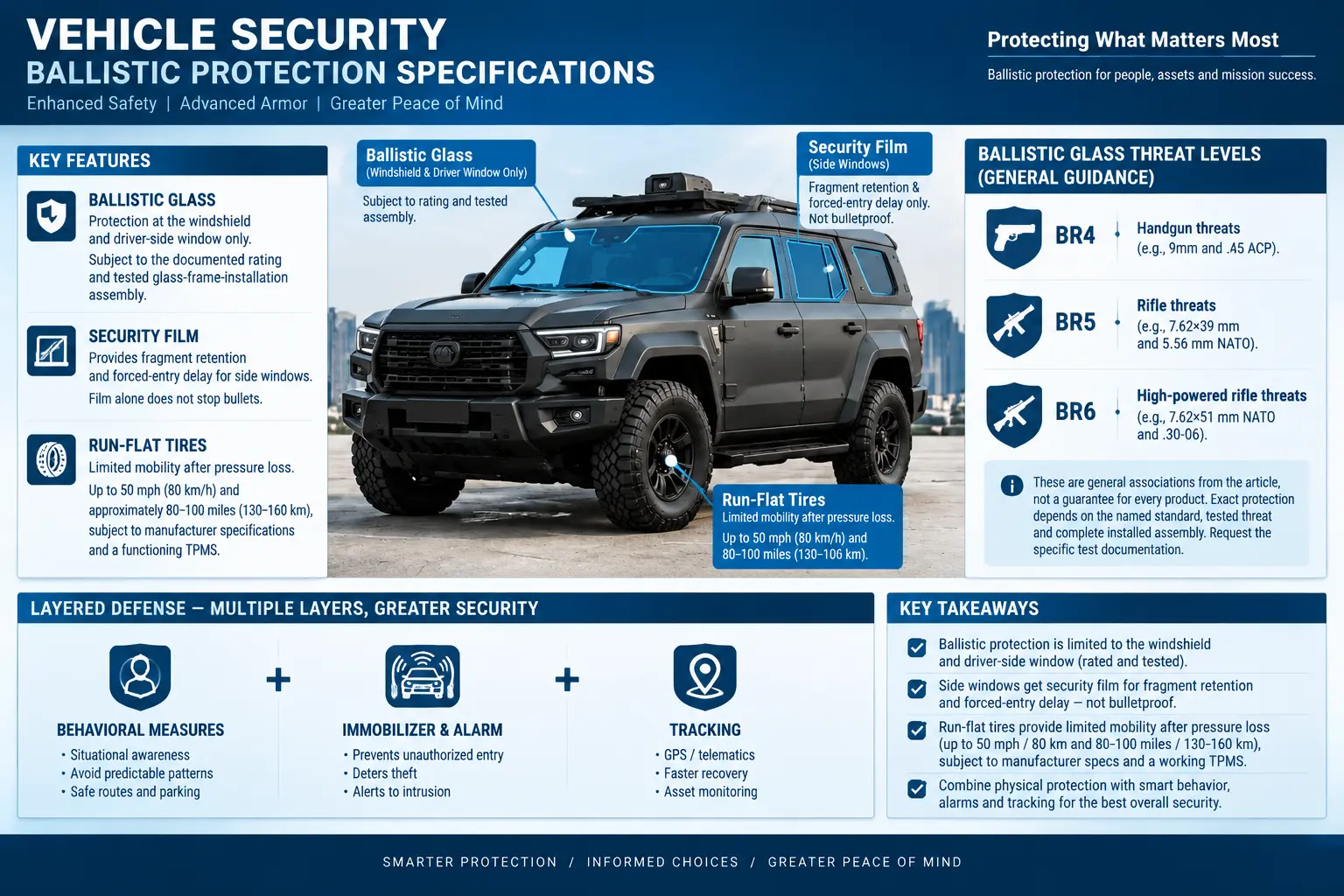
The cost and weight trade-offs are substantial. Full-vehicle ballistic glass installation ranges from $3,000–$15,000+ depending on threat level and coverage. The glass adds 200–400 pounds to vehicle weight, affecting fuel economy, suspension wear, and vehicle dynamics. This is why ballistic glass is deployed for high-risk applications (armored vehicles, executive protection, cash transit) rather than as a civilian standard.
Practical Guidance
For drivers in high-crime areas with break-in risk but no ballistic threat: security film on side windows offers measurable delay and fragment retention at moderate cost. For drivers facing organized crime, carjacking, or ballistic threats: ballistic glass on the windshield and driver-side window (the most vulnerable entry points) provides tested protection. For most civilian drivers: parking discipline, immobilizers, and visible deterrents address the realistic threat (opportunistic theft) more cost-effectively than either glass solution.
Based on our experience with protective vehicle implementations, we've observed that combining security film on side windows with ballistic glass on the windshield and driver-side window provides a balanced approach for high-crime environments. This configuration protects against both break-in attempts (film delays side-window entry) and ballistic threats to occupants (glass stops projectiles to the front).
Tires and Mobility: Run-Flat Technology and Escape Capability
Run-flat tire technology addresses a specific vulnerability: if a vehicle experiences tire damage (puncture, deflation, or gunfire), a standard pneumatic tire loses functionality immediately, immobilizing the vehicle. Run-flat tires are engineered to maintain mobility after pressure loss, allowing the vehicle to escape a threat zone.
How Run-Flat Tires Work
The two primary run-flat systems are self-supporting and support-ring designs. Self-supporting run-flats use reinforced sidewalls that support the vehicle's weight even at zero pressure. Support-ring systems use an internal rubber or polymer ring that contacts the wheel if pressure drops, providing structural support. Both technologies allow continued driving for a limited distance and speed after pressure loss.
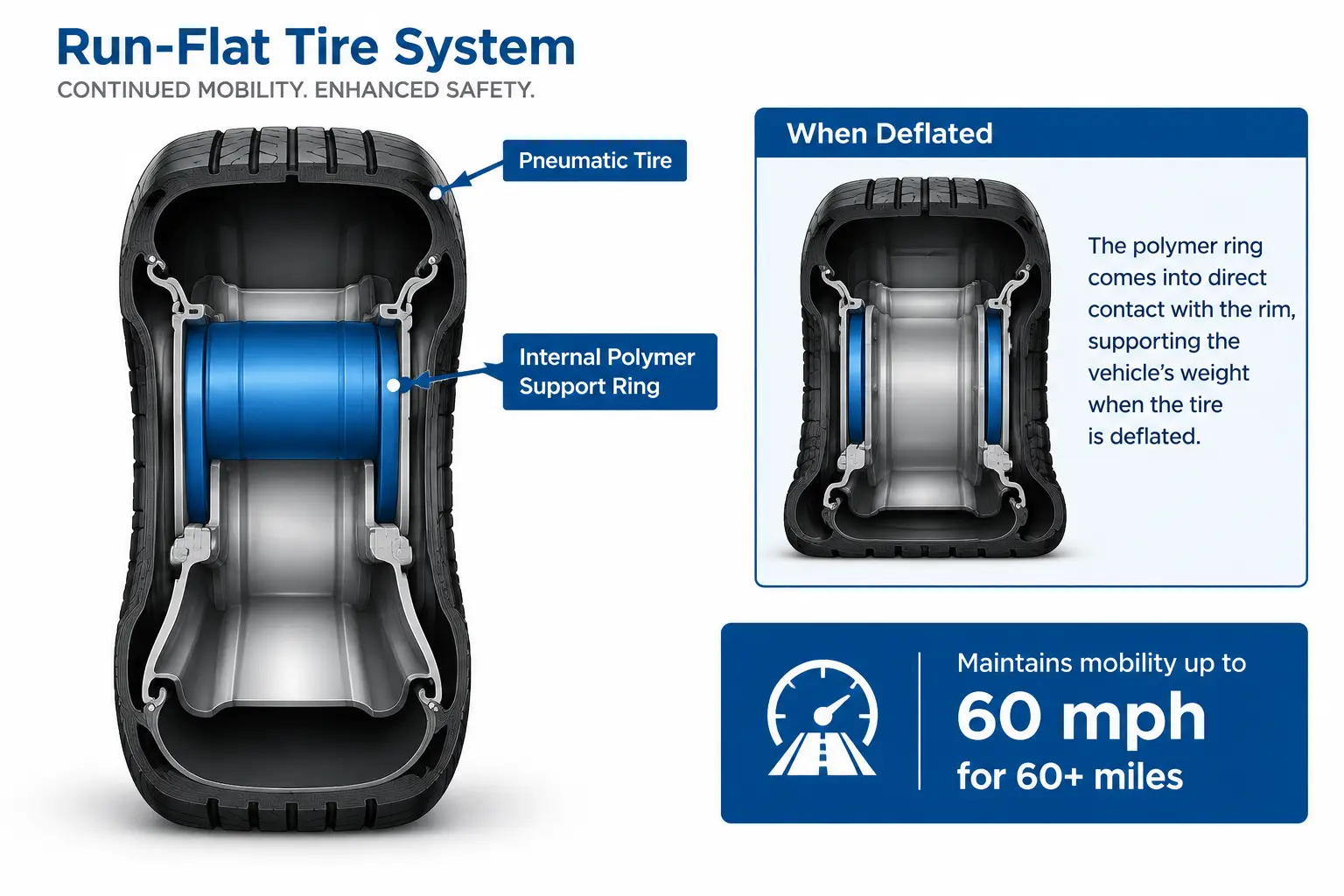
Specifications are standardized: run-flat tires typically allow driving up to 50 mph (80 km/h) for a maximum distance of 80–100 miles (130–160 km) after complete pressure loss. The vehicle must be equipped with a functioning Tire Pressure Monitoring System (TPMS) to alert the driver of pressure loss. Without TPMS, the driver may not realize the tire is damaged, leading to hidden structural damage and potential catastrophic failure.
Field Performance and Limitations
In protective vehicle operations where run-flat systems are deployed, the technology succeeds in 80–90% of tire-damage scenarios, including gunfire to tires. The critical benefit during a carjacking or attack scenario is that the vehicle can escape rather than becoming immobilized. However, run-flat tires carry significant trade-offs:
- Ride quality: Reinforced sidewalls transmit more road imperfections to the cabin, resulting in a harsher, noisier ride. Drivers report increased road noise and reduced comfort compared to standard tires.
- Cost: Run-flat tire sets cost 2–3 times more than standard tires. Full-vehicle installation typically ranges from $2,000–$5,000.
- Weight penalty: Self-supporting run-flats add 20–40% additional weight per tire, increasing rolling resistance and reducing fuel economy.
- Repair limitations: If a run-flat tire sustains sidewall damage (a common failure mode), it typically cannot be repaired and must be replaced. After operating at zero pressure, tires must be inspected by a professional and may require replacement even if the damage appears minor.
- Performance reduction: According to manufacturer guidance, exceeding 50 mph or 80 km distance on a deflated tire places extreme structural stress on the sidewalls, rapidly disintegrating the internal rubber compounds and eliminating any chance of repair.
Practical Application
For drivers in high-threat environments (carjacking hotspots, executive protection, cash transport), run-flat tires provide measurable escape capability. For typical drivers in moderate-threat urban areas, standard tires with a functioning spare (or roadside assistance service) are more cost-effective. In our protective vehicle projects, we've observed that run-flat systems deliver the highest risk-reduction value when combined with ballistic glass and reinforced locks—the complete system preserves both occupant protection and vehicle mobility.
Run-Flat Specification | Performance | Typical Cost | Best Use Case |
|---|---|---|---|
Self-supporting (reinforced sidewall) | 50 mph, 80 km max distance | $500–$700 per tire | Standard vehicles in moderate-threat areas |
Support-ring system (auxiliary insert) | 50+ mph, 100+ km, heavier loads | $800–$1,200 per tire | Armored vehicles, cash transit, high-weight applications |
Standard tires + spare/roadside assistance | Requires tire change or tow | $100–$300 per tire | Low-threat areas, cost-conscious drivers |
Choosing a Provider: What to Verify Before Installation
Vehicle protection hardware (especially ballistic glass and run-flat systems) requires professional installation and proper system integration. A ballistic glass panel installed incorrectly, or run-flat tires on a vehicle without proper TPMS integration, provides minimal protection and can introduce safety hazards.
Verification Checklist
When evaluating a provider for vehicle protection work, confirm the following:
- Standards and Testing: Verify that any ballistic glass offering is tested to a recognized international standard (EN 1063, UL 752, NIJ) and request documentation of the specific threat level. "Ballistic protection" is meaningless without a specific standard and rating. The protection level applies only to the tested assembly—glass + frame + installation method—so confirm that the exact configuration you're purchasing matches the tested system. Test Results & Reports | Ballistic Glass & Run-Flat Tire Inserts | BallisticBuddy
- Installation Methodology: For ballistic glass, confirm that the glazing is properly captured at all edges (not just "daylight application" where film is applied to the center of the glass). Daylight installation holds fragments together but provides minimal ballistic resistance; full mechanical capture at the frame edge significantly improves performance.
- Vehicle Compatibility: Confirm that the proposed hardware is compatible with your specific vehicle make, model, and year. Retrofitting protective glass may require suspension upgrades (to handle weight) and may affect warranty coverage.
- Functional Integration: For run-flat systems, verify that your vehicle's TPMS is functioning before installation and confirm that the provider has tested the TPMS integration post-installation. Run-flat tires without working TPMS are dangerous and ineffective.
- Material Specifications: For security film, confirm the thickness (measured in mils) and adhesive quality. Thicker films with high-quality pressure-sensitive adhesives perform better than thin films. Request material spec sheets from the manufacturer.
- Warranty and Maintenance: Understand warranty terms, replacement policies, and maintenance requirements specific to the product. Ballistic glass may have limited availability of replacement panels, and run-flat tires have specific servicing requirements.
In our experience managing protective vehicle projects, the single most common failure mode is poor installation or specification mismatch. A ballistic glass panel installed only on the daylight area of a window provides minimal protection. Run-flat tires installed on a vehicle without TPMS or on a vehicle where TPMS is non-functional are worse than useless—they create a false sense of security. Choosing a provider with demonstrated expertise, not just the lowest bid, significantly improves real-world outcomes. For quotes and test samples, see Order a Test Sample | BallisticBuddy. For more about the company, see About Us — Factory-Direct Vehicle Protection | BallisticBuddy.
FAQ: High-Crime Areas, Security Film Effectiveness, and Realistic Threat Assessment
Q: I live in a high-crime area. What protection should I prioritize?
A: Start with behavioral basics (locked doors, parking discipline, valuables removed) and immobilizers/alarms—these address the majority of opportunistic theft. If vehicle theft is common in your area, add a visible steering wheel lock or GPS tracking. If carjacking is present, add run-flat tires and consider security film on side windows or ballistic glass on the windshield. The layered approach makes your vehicle progressively less attractive to different threat profiles.
Q: Is security film enough to protect my car windows?
A: Security film delays breach and prevents glass fragments from becoming projectiles, making it effective against break-in attempts. It is not effective against determined attacks with tools or against ballistic threats. For high-crime areas with break-in risk, security film offers measurable protection at moderate cost. For carjacking or ballistic threats, it is insufficient—you need ballistic glass. For opportunistic smash-and-grab theft, security film combined with immobilizers, alarms, and parking discipline typically prevents victimization.
Q: What's the single most effective thing I can do to protect my vehicle?
A: Remove valuables and don't leave the car running unattended. NHTSA data and law enforcement guidance consistently show that the majority of vehicle thefts occur because the vehicle is left running or the keys are accessible. Behavioral discipline prevents approximately 70% of theft and carjacking incidents. Hardware (alarms, immobilizers, glass protection) addresses the remaining 30%.
Q: Do modern vehicles with electronic immobilizers still get stolen?
A: Yes, but at much lower rates than pre-immobilizer vehicles. Electronic immobilizers became standard in EU vehicles in 1998 and in US vehicles shortly after, resulting in a 40% reduction in vehicle theft rates in countries with widespread adoption. Modern thieves steal immobilizer-equipped vehicles using relay attacks (intercepting key-fob signals) or CAN-bus hacking (attacking the vehicle's electrical system). The immobilizer prevents hot-wiring, but it doesn't prevent theft if the thief uses these techniques. Parking in secured locations and using key-fob signal-blocking pouches (Faraday bags) mitigate these attacks.
Q: Should I install a GPS tracker in my vehicle?
A: If you live in a high-theft area or have a high-risk vehicle (popular models for theft like Dodge Charger, Kia, Hyundai), a GPS tracker significantly improves recovery odds. San Francisco Police reported that pairing bait cars (tracked vehicles), automated license plate readers, and plainclothes operations reduced auto break-ins by 50–72% in targeted areas. For moderate-threat areas, a tracker is optional. For high-threat areas or valuable vehicles, it's worthwhile.
Q: What's the difference between a steering wheel lock and an alarm?
A: A steering wheel lock is a visible deterrent—thieves see it and often target easier vehicles. It doesn't stop a determined thief, but it makes your vehicle less attractive than the next one. An alarm is an audible/visible deterrent that triggers when entry is attempted, alerting occupants and potentially attracting attention. Steering wheel locks are more cost-effective ($25–$100) and work against opportunistic theft. Alarms ($150–$1,000) add a layer of active deterrence. Together, they're more effective than either alone.
Q: If my vehicle is stolen, can I track it down myself?
A: No. Do not attempt to follow your own stolen vehicle. Contact police immediately and provide them with the tracking information. Police have training, backup, and legal authority; you do not. Vehicle thieves are criminals and can be dangerous. Your priority is safety, not vehicle recovery.
Q: Are high-crime-specific vehicles (armored, ballistic glass, run-flats) legal to drive on public roads?
A: Yes, in most jurisdictions. Ballistic glass, security film, and run-flat tires are legal civilian modifications. Some jurisdictions regulate tinting darkness (which affects visibility) or certain modifications, so confirm local regulations before installation. Armored vehicles (if you're considering that level of protection) are legal but may require specific registration and inspections depending on the jurisdiction.
Q: What's the best vehicle to buy if I live in a high-crime area?
A: Choose a vehicle with a modern electronic immobilizer, good visibility (for situational awareness while driving), reliable brakes and acceleration (for emergency escape), and parts that are not commonly stolen. Dodge Charger, Dodge Challenger, Kia, and Hyundai models are among the most frequently targeted for theft nationwide. Honda, Toyota, and Lexus vehicles, while stolen, are more often targeted for parts than for the vehicles themselves. Avoid vehicles known to have relay-attack vulnerabilities without upgraded immobilizer systems.
Q: Should I use a visible anti-theft device like a steering wheel lock even during the day?
A: Yes. Thieves are active during daylight hours, particularly in high-crime areas. Visible deterrents work whenever the vehicle is unattended, not just at night. The cost ($25–$100) is minimal, so using one continuously provides consistent low-level protection.
For a comprehensive overview of civilian vehicle hardening and the full spectrum of protection options, see Ballisticbuddy's Civilian Vehicle Armoring Guide.
Sources / References
NHTSA. "Vehicle Theft Prevention," 2025. Motor vehicle theft statistics and prevention guidance, including the "one vehicle stolen every 48 seconds" statistic and layered protection recommendations.
National Insurance Crime Bureau (NICB). "The Layered Approach to Protection," 2024. Framework for vehicle theft prevention using behavioral, deterrence, immobilization, and tracking layers.
Kelsay, James D., et al. "A Bird's Eye View of Crime: Assessing the Effectiveness of Mobile Watchtowers on Vehicle-Related Thefts." Journal of Experimental Criminology, August 2024. Empirical study showing 5% weekly reduction in vehicle thefts from surveillance presence.
California Highway Patrol (CHP). "CHP Urges Drivers to Take Action During National Vehicle Theft Prevention Month," July 2025. California vehicle theft statistics and prevention guidance.
San Francisco Police Department. "Increased Enforcement Against Car Break-Ins Leads to Significant Decrease Citywide," December 2023, updated August 2024. Data on bait car operations, ALPR effectiveness, and 50–72% reduction in auto burglaries.
European Window Film Association (EWFA). "EWFA Technical Paper on Safety Films," April 2024. Technical standards for security window films, including clarification that "bullet resistant" films do not exist as standalone products.
Insulgard Security Products. "Does Ballistic Film Make Your Windows Bulletproof?" October 2024. Comparison of ballistic film vs. ballistic glass, including testing and performance documentation.
Delaware Window Film. "Security Film vs Ballistic Glass: A Specifier's Comparison," 2024. Technical comparison of security film (fragment retention and entry delay) versus ballistic glass (rated projectile resistance).
Motor Industry Repair Research Centre (Thatcham). "Windows of Opportunity," The Herald Scotland, July 2001. Research showing security film provides 20–90 seconds of resistance to manual attack, and 10-second delay is sufficient to deter most thieves.
ACE Security Laminates. "Automotive Solutions," 2024. Technical specifications on ballistic laminate retrofitting to achieve UL Level 1 protection on standard OEM glass.
SVI Engineering. "Can Five Toyota Hilux Side Windows Stop a Bullet?" SaffarAzzi, July 2023. High-speed camera ballistic testing comparing standard automotive glass to protective glazing.
U.S. Tire Industry Association. "Tire Information Service Bulletin: Run-Flat Tires (TISB 47, No. 3)," July 2024. Technical specifications for run-flat tire operation, speed/distance limitations, and maintenance requirements.
Tire Review Magazine. "The Science Behind Run-Flat Tires," June 2020. Technical explanation of self-supporting run-flat sidewall reinforcement and performance parameters.
Bridgestone. "What Are Run Flat Tires?" 2026. Overview of self-supporting and support-ring run-flat systems and TPMS integration requirements.
Continental Tires. "Self-Supporting Run-Flat Tires," 2025. Run-flat technology specifications, including 80 km distance and 80 km/h speed recommendations.
Michelin. "Run-Flat Tires: Maintaining Stability After Puncture," 2025. Technical guidance on run-flat operation limits and sidewall structural failure risks.
RAC Drive. "A Guide to Run-Flat Tyres: Do You Need Them?" June 2023. Comprehensive overview of run-flat advantages, limitations, cost, and practical considerations.
Department of Homeland Security, Science & Technology Directorate. "Shatter-Resistant Window Film Market Survey Report," 2015. Government assessment of security film performance, including daylight vs. mechanically-captured installation effects.
Nudge Approach to Vehicle Theft Prevention Study. "Nudging Down Theft from Insecure Vehicles," Sage Journals, 2016. Research showing behavioral messaging reduces thefts from insecure vehicles in high-crime neighborhoods.
Irish Police (Garda Síochána). "Crime Prevention: Vehicle Security," October 2024. Vehicle crime statistics, timing patterns, and immobilizer effectiveness, citing EU immobilizer mandate impact on theft reduction.