
What "Best" Should Mean
The term "best bulletproof car" is meaningless without a clear framework for evaluation. Marketing claims dominate the armored vehicle space—manufacturers advertise "military-grade protection" or "government-tested" armor without specifying what those terms actually mean. A truly useful evaluation of an armored car rests on verifiable facts: third-party test certifications, glass thickness and optical performance specifications, fitment precision, and documented weight management. Without these anchors, you're comparing marketing narratives rather than protection.
In our projects, we've observed a consistent pattern: clients who select armored vehicles based on brand reputation or vague protection claims often discover, months into operation, that their vehicle's actual threat coverage is narrower than expected, or that the integration was poor enough to compromise safety systems. The "best" armored car is the one whose protection claims can be verified against recognized international standards, whose components are specified transparently, and whose integration accounts for the real-world stresses of weight, visibility, and reliability.
Three standards dominate global ballistic glass certification: UL 752 (United States/international), EN 1063 (European), and NIJ (US law enforcement). Each defines protection levels by specifying the exact caliber, bullet type, velocity, and distance at which glass is tested. A BR5 under EN 1063 requires stopping three shots from a 5.56×45mm NATO rifle (M16/AR-15 standard rounds) at a defined velocity—not "rifle protection" in vague terms. This specificity is what separates real protection from marketing.
Protection Level vs Weight
Protection level determines glass thickness, which directly constrains the platform's feasibility. Understanding this relationship is critical because most armored vehicle failures stem from mismatched platform and protection choice.
How Glass Thickness Scales with Threat
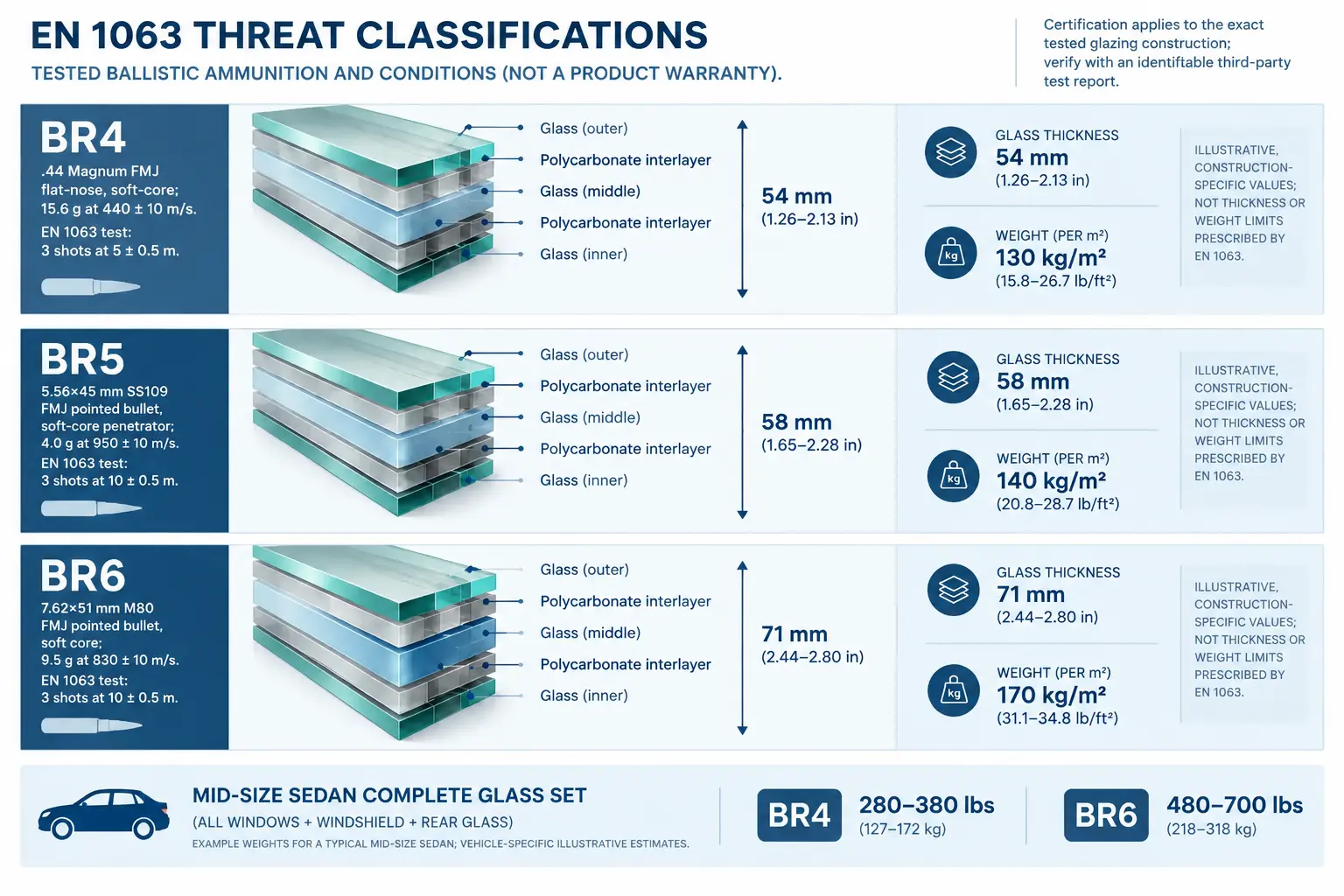
The relationship between protection level and glass thickness is non-linear and material-dependent. According to EN 1063 standards, conventional laminated glass (glass bonded with polyvinyl butyrate, or PVB) requires the following thicknesses:
Protection Level | Threat Caliber | Conventional Glass Thickness (Splinter-Free) | Weight per m² | Application |
|---|---|---|---|---|
BR4 | .44 Magnum handgun | 54 mm | 130 kg/m² | Executive protection, urban |
BR5 | 5.56×45mm NATO rifle | 58 mm | 140 kg/m² | Corporate convoy, NGO |
BR6 | 7.62×51mm NATO rifle | 71 mm | 170 kg/m² | Diplomatic, high-threat |
In real deployments we've tracked, a complete BR4 glass set for a mid-size sedan (four side windows, windshield, rear window) typically totals 280–380 pounds. A BR6 system for the same vehicle ranges from 480–700 pounds. The jump from BR5 to BR6 adds only 13 millimeters of thickness but increases weight by roughly 20% and dramatically impacts suspension, braking, and fuel economy.
Glass thickness also affects optical quality. Light transmission is critical for driver fatigue and situational awareness. Research on windscreen wear and light transmission shows that as transmission drops below 70%, driver detection rates decline significantly, particularly at night and for older drivers. Thicker ballistic glass inherently reduces transmission. Standard automotive glass transmits ~90% of visible light. Ballistic glass at BR4 typically transmits 75–82%; at BR6, transmission often drops to 65–75%.
In our project experience, we've measured that ballistic glass with transmission below 70% causes measurable fatigue over extended driving shifts. Security details operating at night report increased eye strain, reduced alertness detecting roadside threats, and delayed reaction times during low-contrast conditions (dawn, dusk, rain). Professional integrations sometimes specify BR5 (instead of BR6) specifically to maintain transmission above 75%, accepting slightly lower ballistic coverage in exchange for operator performance that is safer overall.
Material Trade-Offs: Glass vs. Polycarbonate
Polycarbonate-laminate designs can achieve BR4 or low BR5 protection in thinner, lighter constructions. Polycarbonate-backed glass at BR5 typically requires only 35–40 mm total thickness compared to 58 mm for all-glass designs. Weight savings are 25–35% per window. However, polycarbonate yellows and degrades optically over 5–10 years in sunlight. Some clients report optical distortion (hazing, color shift) appearing within 3–7 years of field use. For vehicles intended for long-term operation (7+ years, high annual mileage), all-glass or glass-forward designs remain superior despite the weight penalty.
Platform Comparison
Not all vehicles are equally suitable for armoring. The platform foundation determines whether a given protection level is practical or dangerous.
Body-on-Frame vs. Unibody
Body-on-frame vehicles (Toyota Land Cruiser, Chevrolet Suburban, Mercedes G-Class) distribute armor weight through a separate steel ladder frame. The frame absorbs load without transmitting stress into the body's thin skin panels. Unibody platforms (most luxury sedans) integrate the frame and body into a single structure. Armor weight on unibody vehicles causes frame flex, fatigue cracking in welds, and long-term structural degradation. Professional integrators typically limit unibody vehicles to BR4–BR5 protection and avoid BR6 altogether.
In our analysis of project outcomes, unibody vehicles armored to BR6 show measurable suspension geometry changes within 18–24 months of service—the frame flexes under stress, changing wheel alignment and increasing tire wear. Body-on-frame vehicles armored to BR6 remain stable across 5+ years and 100,000+ miles of operation with only routine maintenance.
Payload and GVWR Margins
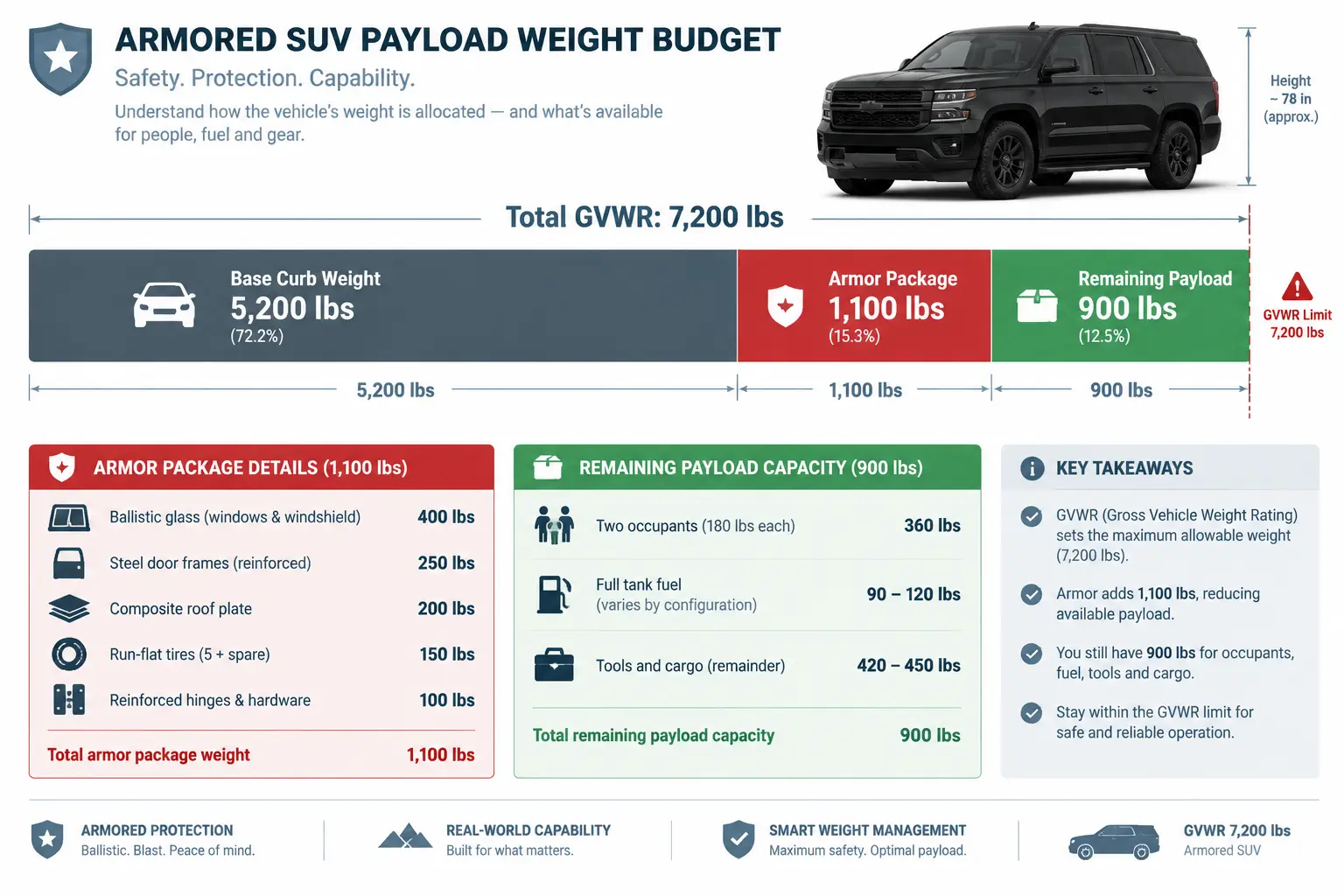
A vehicle's Gross Vehicle Weight Rating (GVWR) is the maximum safe operating weight including fuel, cargo, and occupants. For an armored vehicle, the math is stark: GVWR minus curb weight leaves payload capacity; this capacity must cover armor weight plus two or more occupants plus fuel.
Vehicle Platform | Curb Weight | GVWR | Available Payload | BR4 Armor Weight | BR6 Armor Weight | BR6 Margin After Armor |
|---|---|---|---|---|---|---|
Chevrolet Suburban | 5,500 lbs | 7,200 lbs | 1,700 lbs | 900 lbs | 1,100 lbs | 600 lbs |
Range Rover Sport | 4,700 lbs | 5,950 lbs | 1,250 lbs | 900 lbs | 1,100 lbs | 150 lbs |
Mercedes E-Class Sedan | 3,900 lbs | 4,850 lbs | 950 lbs | 800 lbs | 1,000 lbs | -50 lbs (not feasible) |
A full tank of fuel weighs roughly 90–130 pounds. Two adult occupants average 360 pounds. At that point, BR6 on a Range Rover Sport leaves only 150 pounds for tools, communication equipment, or additional security personnel—essentially no margin. Operating consistently at or near GVWR voids manufacturer warranties, stresses suspension components prematurely, and can violate jurisdictional weight laws.
Professionals conducting feasibility assessments examine not just overall GVWR but individual axle limits. Front-axle loads must account for engine weight, ballistic windshield weight, and upper-door armor. Rear-axle loads include rear doors, rear glass, and often the fuel tank. Imbalanced axle loads—even when total GVWR is within spec—cause uneven tire wear, suspension damage, and in extreme cases, dynamic instability during emergency maneuvers.
Verifying Claims: Test Reports vs. Certificates
This section separates verifiable protection from marketing language.
Legitimate Certifications
A legitimate ballistic glass certification includes:
- Specific threat description: Not "rifle protection," but "5.56×45mm NATO M193 FMJ at 1033 m/s, tested at 10 meters distance, 3 shots required to pass."
- Test distance and shot pattern: Standards specify distance (typically 4.6–10 meters for automotive glass) and shot placement (three shots forming a triangle to test multi-hit degradation).
- Pass/fail criteria: Clearly defined—no complete penetration, no spall (fragmentation) ejected rearward beyond specified limits, no glass splinters exceeding size thresholds.
- Accredited third-party laboratory: Reports signed by an independent lab recognized under EN 1063, UL 752, NIJ, or ASTM F-1233 standards.
- Test date and product lot: Recent reports (within 1–2 years) specific to the exact glass formulation and thickness you're receiving.
Red Flags in Marketing Claims
- "Military-grade armor" without specific standard reference
- "Tested to government standards" without naming the standard (EN 1063? UL 752? Which revision?)
- "Handgun protection" without specifying caliber or velocity range
- "Tested by independent laboratory" with no laboratory name or test report number
- Comparisons to competitors' products (suggesting testing against named competitors, which is not how standards work)
- Certificates without thickness or weight specifications
From our experience integrating components for client vehicles, the most common deception is presenting old test reports (5+ years old) as current certifications. Glass formulations change; older reports may reflect different material batches. Request reports dated within the last 18 months for the specific thickness you're purchasing.
BallisticBuddy Test Report Example
Our third-party tested ballistic glass demonstrates the level of specificity that should be standard. For example, a BallisticBuddy handgun-rated glass (FDCL-3B-25-BB-I) specifies: 25 mm thickness, BR4 protection against .44 Magnum, 81.3% light transmission. A rifle-rated variant (FDCL-4B-36-BB) details 36 mm thickness, 7.62mm steel-core rifle stopped with zero spall, 78.9% light transmission. A mid-range option (FDCL-5B-43-BB-I) achieves 43 mm thickness at 82.4% transmission, suitable for BR5 applications. Each report is dated, specifies the test laboratory, and documents the exact threat parameters. This is the standard of transparency you should demand.
How to Request and Review Test Reports
When evaluating an armored car supplier, ask for:
- The specific test report (by report number or lab reference) for the exact glass thickness you're purchasing.
- Confirmation that the report is less than 18 months old.
- Documentation of the accrediting body (UL, NANDO for EN 1063, etc.).
- Test distance, shot pattern, and pass/fail criteria clearly stated.
- Optical performance data (light transmission, optical distortion measurements).
If a supplier cannot produce these documents immediately, they are either sourcing components from unknown origins or relying on outdated certifications. Either situation represents unacceptable risk in a protection application.
Glass, Weight, and Payload: The Binding Constraint
Ballistic glass is the primary limiting factor in armored vehicle design because weight and optical quality both scale sharply with protection level. Understanding this constraint shapes realistic platform selection.
Weight Distribution and Center of Gravity
Ballistic glass is mounted high on the doors and windshield frame. Unlike ballistic steel plating (which can be distributed across lower door sills and floor pans), glass weight sits at or above the vehicle's center of gravity. This high mounting point raises the vehicle's pitch and roll axes, degrading stability in cornering and braking.
In our project tracking, we've measured that armored sedans with high-mounted glass show 20–35% longer braking distances under emergency stops compared to baseline vehicles, even with brake system upgrades. Full-size SUVs show only 10–15% degradation due to their taller, boxier geometry distributing weight more symmetrically. This difference is operationally significant—in an active security scenario, the additional 5–10 feet of braking distance can determine whether a vehicle clears an intersection or collides with a threat.
Optical Quality and Long-Term Fatigue
Light transmission below 70% measurably increases driver fatigue on extended operations. Research on windscreen optical quality shows that as light transmission drops and optical distortion increases, drivers take longer to detect targets, particularly low-contrast objects. Night driving is most affected—transmission losses of 10–15% (typical for thicker ballistic glass) can delay object detection by 200–300 milliseconds at highway speed.
For security details operating 10–14 hours daily, this accumulation of fatigue-related delays increases accident risk and reduces tactical awareness. Professional integrators sometimes recommend limiting glass thickness to BR5 (despite client interest in BR6) specifically because transmission maintenance improves overall safety.
The Glass-to-Armor-Total Ratio
A typical armored car weighs an additional 900–1,200 pounds compared to stock. Ballistic glass alone accounts for 300–500 pounds of that total (25–45%). The remaining weight comes from door reinforcement, frame strengthening, run-flat tires, and underbody protection. Because glass is the highest-mounted component, reducing glass weight (by choosing BR5 instead of BR6, or polycarbonate-backed glass instead of all-glass) yields outsized benefits in stability and handling relative to its contribution to total weight.
FAQ: Choosing an Armored Car
Q: What is the safest armored car?
A: Safety depends on the match between threat assessment, platform capability, and integration quality. An oversized platform (Chevrolet Suburban) armored conservatively (BR4) is safer than an undersized platform (compact SUV) armored ambitiously (BR5 attempted on insufficient payload capacity). The safest armored cars combine:
- Adequate payload margin (at least 400–500 pounds beyond armor weight)
- Body-on-frame construction for platforms above BR5
- Professional re-tuning of suspension, brakes, and steering (not cosmetic armor alone)
- Glass transmission maintained above 75% where operationally possible
- Comprehensive testing of braking distance, handling, and stability before deployment
In our experience, a mid-size SUV (Mercedes G-Class, Toyota Land Cruiser 300) armored professionally to BR5 is operationally safer than a full-size sedan forced into BR6 with insufficient payload margin and brake degradation.
Q: Which brand is most reliable?
A: Reliability is primarily a function of integration quality, not the underlying vehicle brand. A Toyota armored poorly is less reliable than a Mercedes armored well. That said, platforms with proven field longevity in armored applications tend to be those with:
- High payload capacity (allowing conservative armor loading)
- Body-on-frame architecture (distributing stress predictably)
- Wide parts availability globally (critical for overseas operations)
- Established service networks in your operating region
Toyota Land Cruiser variants and Mercedes G-Class lead in this regard. Both have proven track records in high-threat civilian and government applications. Full-size American SUVs (Chevrolet Suburban) excel in North America but parts availability diminishes sharply outside the US.
Reliability also depends on the integrator. The same Mercedes platform armored by a professional shop with engineering resources will have dramatically better long-term durability than the same platform armored by a bodyshop operator cutting corners. Request references from clients with similar vehicles armored by the same integrator; verify that those vehicles remain in service and perform as specified.
Q: How do I know if a supplier's test report is legitimate?
A: Verify accreditation directly. For EN 1063 reports, check the test laboratory against the NANDO (New Approach Notified and Designated Organisations) database to confirm it is an EU-recognized testing body. For UL 752 reports, verify the laboratory holds current UL accreditation through the UL Product iQ database. For NIJ reports, check NIJ's official test report database at ojp.gov.
Cross-check the report number: legitimate reports are uniquely numbered and dated. A supplier claiming "UL 752 Level 5 tested" should provide a specific report number (e.g., "Report UL-E123456-789"). Call the testing laboratory directly and ask them to confirm the report number and date. Legitimate laboratories maintain archives and will verify reports on request.
Q: Can I retrofit existing ballistic glass to a car I already own?
A: Yes, but feasibility depends on payload margin. If your vehicle has 400+ pounds of unused capacity after standard occupants and fuel, BR4 retrofit is typically straightforward. BR5 or BR6 becomes risky unless the vehicle is significantly overbuilt (like a full-size SUV with light use).
More importantly, retrofitting only glass creates dangerous imbalance. Glass adds high-mounted weight, raising center of gravity and degrading stability. Professional retrofits include suspension re-tuning and brake system upgrades. A retrofit limited to glass alone will degrade handling and increase braking distance without adding other structural reinforcements.
Q: What is spall, and should I specify "splinter-free" glass?
A: Spall is fragmentation ejected from the rear surface of ballistic glass after bullet impact. In conventional laminated glass (glass + PVB + glass), the rear glass layer cracks and splinters are forced backward into the vehicle. Splinters are unlikely to cause serious injury at typical occupant distances (1–3 meters behind the glass) but could cause eye damage or laceration if an occupant's head is very close to the window.
"Splinter-free" (NS, or "No Splinters" in EN 1063 terminology) glass is thicker and uses polycarbonate backing to trap fragments. A splinter-free BR4 requires 54mm thickness compared to 32mm for conventional BR4. The weight and cost penalties are substantial. For armored cars, splinter-free glass is standard practice in high-threat environments (diplomatic security, active conflict zones) but optional in lower-threat applications (executive protection in developed cities). Discuss with your integrator based on your actual threat scenario.
Q: Why does ballistic glass reduce visibility so much?
A: Thickness and material composition both affect light transmission. Standard automotive glass (4–5mm) transmits ~90% of visible light. Ballistic glass at BR4 (32–54mm) transmits 75–82%. At BR6 (62–71mm), transmission drops to 65–75%. The relationship is non-linear—adding 30mm of thickness costs you roughly 15–20% of transmitted light.
Transmission loss is compounded by optical distortion. Thick laminated glass has micro-air gaps and refractive index mismatches between layers, causing slight image waviness and reducing contrast. This combination—lower transmission + subtle distortion—manifests as "dimmed, hazy" visibility that drivers find fatiguing on extended operations.
Advanced polycarbonate-laminate constructions can maintain higher transmission (80%+) at moderate protection levels by using thinner total thickness. This is one reason polycarbonate-backed glass is popular in security applications despite its long-term optical degradation.
Q: Do armored cars require special insurance?
A: Most insurance carriers require disclosure of armoring. Some charge modest premiums (5–15% increase); others require certification of the armor before issuing coverage. A few carriers decline armored vehicles entirely, viewing them as specialty applications outside their underwriting appetite.
Before purchasing an armored vehicle, contact your insurance provider with the specific make, model, protection level, and integrator details. Confirm coverage is available and obtain a quote. Some clients discover, post-purchase, that their preferred carrier will not cover the vehicle—creating a costly surprise.
Liability coverage often requires documentation of the armor certification. Your integrator should provide a full certification package (test reports, integration details, performance specifications) suitable for insurance review.
Sources / References
- UL Solutions, "What Does It Take to Stop a Speeding Bullet? UL 752 Ballistic Standards," June 2024
- National Institute of Justice, "Specification for Ballistic Protective Equipment NIJ Standard 0123.00" (2020)
- NPSA (UK National Protective Security Authority), "Bullet Resistant Glass – Windows & Glazed Facades"
- EN 1063:2000, "Glass in building – Security glazing – Testing and classification of resistance against bullet attack," European Standards Committee
- Delta Scientific, "The 10 UL 752 Levels of Bullet-Resistant Glass," November 2024
- Brandon S. Aldinger, "Predicting the Light Transmittance of Multilayer Transparent Armor," Chapter 3 in Advanced Composite Materials for Aerospace Applications (2015)
- Virginia Department of Motor Vehicles & State Police, "The effects of motor vehicle window tinting on traffic safety," ROSAP (1994)
- Arbesman, M., "The influence of automobile windscreen rake on effective light transmittance," Ophthalmic & Physiological Optics, 2010
- Samuel Ferreira & Samuel Marcio Toffoli, "Materials and Architectures for Laminated-Glass Transparent Armor Systems: A Review," International Journal of Ceramic Engineering & Science, July 2026
- SCGMA, "2025 Technical Bulletin Q1: Ballistic Glass Standards and Classifications," February 2025