
Bulletproofing a vehicle is no longer exclusive to government officials or security professionals. As urban security concerns grow globally, civilian demand for armored vehicles has surged, pulling down entry-level costs to ranges that are increasingly accessible. Yet pricing remains opaque across regions, with protection levels, component choices, and installation complexity creating a vast spectrum of options.
Basic armoring starts around $75,000–$90,000 USD (or R590,000–R780,000 ZAR in South Africa) for handgun protection on a mid-size sedan, while rifle-resistant protection ranges from $170,000–$320,000 USD for moderate-threat vehicles, scaling upward to $580,000+ for maximum civilian protection. However, these figures are deceptive without understanding what drives the variance and what actually comprises the bill.
What Determines the Price
Vehicle armoring costs hinge on four fundamental variables that stack multiplicatively rather than additively—meaning two separate choices can compound price impact far beyond their standalone cost.
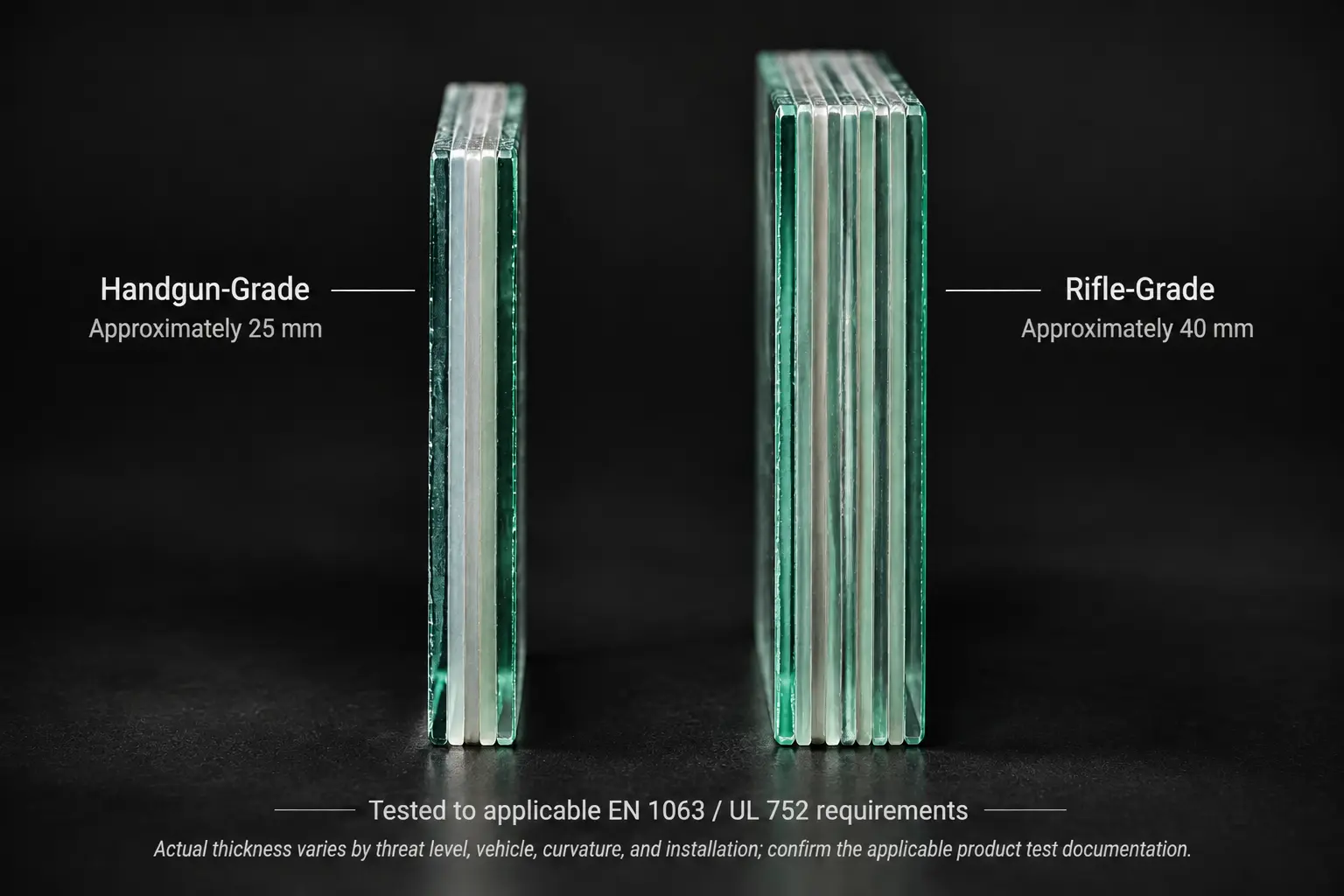
Protection level is the dominant cost driver. Handgun protection requires 19–21mm ballistic glass and lightweight Kevlar composites; rifle protection demands 38–72mm glass with reinforced steel plating. Upgrading from handgun to rifle-level protection typically increases material costs by 150–280%, not accounting for labor and structural modifications. A standard BR4 (handgun, up to .44 Magnum) sedan conversion runs $75,000–$120,000 USD; a BR6 (rifle, AK-47 equivalent) sedan balloons to $180,000–$280,000 USD on the same platform. The jump is non-linear because rifle protection requires additional suspension upgrades, reinforced door hinges, and specialized installation protocols—engineering work that doesn't scale linearly with material thickness.
Base vehicle selection creates 20–40% variance in final price. Compact sedans demand less material than full-size SUVs; luxury European vehicles (BMW, Mercedes, Audi) require 10–20% premium pricing due to complex electronics integration and curved body panel geometry. A Toyota Corolla Cross (compact SUV) B4 package at R694,900 ZAR versus a BMW 7 Series B4 at approximately €95,000+ (roughly equivalent after regional adjustment). The BMW's curved windscreen and integrated driver-assistance systems demanded custom glass cutting and recalibration—adding weeks to production and thousands to labor costs. For curved glass applications, see our curved bulletproof glass for armored vehicles and jewelry showcases.
Material choice—steel versus composite—creates hidden tradeoffs. Traditional ballistic steel (15–25 USD per pound) is economical and battle-tested but adds 450–650kg for BR6 protection. Kevlar composites and advanced polymer layers cost 30–50% more per unit but reduce weight by 35–50%, preserving fuel efficiency and handling. A 650kg armor weight penalty translates to 10–25% increased fuel consumption over vehicle lifetime—a hidden ownership cost worth $8,000–$25,000 over five years. Lighter composite solutions mitigate this, though upfront glass and material costs are higher.
Installation complexity and labor multiply miscellaneous expenses. Custom ballistic glass for curved windows adds 6–12 weeks to production timelines and $3,000–$8,000 to labor. A standard sedan with flat glass installs in 4–6 weeks; a curved-windscreen SUV with 360-degree protection can stretch to 12–16 weeks, with labor charges of $150–$250 USD per hour accruing across extended timelines.
Cost by Protection Level
The industry standardizes protection around EN 1063 (European) and UL 752 (US) ratings, with regional variants like South Africa's BR classifications. Understanding these tiers is essential because each represents a discrete jump in threat capability—not a linear gradient.
BR4 / A4 (Handgun Protection): $75,000–$200,000 USD
BR4 stops rounds from handguns up to .44 Magnum, 9mm full-metal-jacket, and .357 Magnum—covering roughly 85% of civilian armed robbery and hijacking scenarios. Glass thickness ranges 19–21mm; armor comprises cut-and-bonded Kevlar sheets in body panels and lightweight steel in pillars. Weight addition is 110–280kg, absorbed by most vehicles without suspension upgrades. B4 sedan conversions range R690,000–R720,000 ZAR (approximately $38,000–$40,000 USD at current exchange rates), while bakkies start at R479,900 ZAR. US pricing reflects higher labor costs: Alpine Armoring quotes $75,000–$120,000 USD for a comparable sedan, with luxury marques at the upper end.
The BR4 sweet spot attracts families, corporate shuttles, and professionals in moderate-threat environments. Operationally, driver windows still open 40–50%, preserving everyday usability. Fuel economy degradation is minimal (2–8%), and handling remains nearly stock. Critically, BR4 conversions are usually completed without manufacturer warranty voiding—many OEM partners now offer factory-approved BR4 packages (as with Ford, Toyota, and Lexus in South Africa) that preserve service plans and resale value. For a threat-based approach to vehicle protection, see How to Protect Your Vehicle: A Threat-Based Approach.
BR5 / A5–A6 (Intermediate Rifle Protection): $170,000–$320,000 USD
BR5 stops AK-47 and 7.62x39mm rounds, representing a threshold jump. Glass expands to 28–38mm; structural steel plating becomes pervasive. Weight penalty reaches 300–500kg. BR5 conversions are rare in civilian markets outside high-threat regions—most opt for BR4 or jump directly to BR6. However, BR5 exists as a transitional option for threat environments that exceed typical handgun scenarios but don't justify full BR6 investment. Pricing in South Africa for BR5-equivalent configurations (often marketed as "intermediate B6") ranges R980,000–R1,180,000 ZAR for medium SUVs.
BR6 / A7–A12 (Rifle + Extended Threat): $180,000–$600,000+ USD
BR6 represents maximum civilian protection short of military-grade armor. It stops assault rifle rounds, including armor-piercing variants, and scales upward to .50 BMG equivalent on specialized platforms. Glass thickness reaches 38–72mm; structural reinforcement becomes pervasive—engine block protection, firewall armor, fuel tank shielding, and belly plating. Weight penalty is severe: 450–650kg baseline, often exceeding vehicle design limits and necessitating suspension overhauls, reinforced door hinges, and brake system upgrades. Fuel consumption increases 15–25%; handling becomes noticeably heavier; and doors require significant effort to operate.
South African BR6 pricing reflects these complexities: R1,180,000–R1,450,000 ZAR for medium to large SUVs (approximately $65,000–$80,000 USD armoring cost, excluding vehicle). US market pricing via Alpine Armoring runs $200,000–$580,000 USD depending on platform and customization. A BR6 luxury sedan (e.g., BMW 7 Series) approaches $400,000–$450,000 USD total armoring cost; a BR6 full-size SUV (Range Rover, Escalade ESV) ranges $280,000–$350,000 USD. For details on how armor affects SUVs specifically, see Bulletproof SUVs: What Armor Does to an SUV and How to Choose One.
Component vs Whole-Vehicle Cost
A critical misconception: bulletproof car pricing is not monolithic. Customers encounter both component-level quotes and integrated whole-vehicle packages, and the distinction materially affects decision-making.
Component-Level Pricing (Material-Focused)
Ballistic glass costs $30–$100 USD per square foot for handgun protection; $150–$600+ USD per square foot for rifle protection. A four-window sedan package (approximately 40–50 square feet of glazing) runs $1,200–$5,000 USD for BR4, scaling to $6,000–$30,000+ USD for BR6. However, glass cost alone is misleading—installation labor, structural framing, weather sealing, and sensor reintegration (for driver-assistance systems) can equal or exceed material cost. Explore our Bulletproof Vehicle Glass specifications and Armored Vehicle Glass Structure Viewer for detailed technical data.
Ballistic armor plating runs $15–$25 USD per pound. A typical BR6 conversion requires 600–1,500 pounds of reinforced steel plating, translating to $9,000–$37,500 USD in material alone. Add cutting, fitting, bonding, painting, and interior/exterior finishing, and labor costs often double the material expense.
Run-flat tires and inserts represent a standalone decision. Factory run-flat tires cost $350–$1,500 USD per tire (roughly $1,400–$6,000 USD for a four-tire set), while aftermarket run-flat inserts (like Flatsover) range $600–$850 USD per unit. A complete four-wheel run-flat system for an armored vehicle typically costs $1,400–$6,000 USD depending on wheel size and insert grade. In South Africa, Flatsover inserts start at R43,786 ZAR (~$2,343 USD) for a four-ring set. Notably, run-flat tires are frequently quoted separately from armoring packages, creating confusion over "total cost." See our Bulletproof Tires & Run-Flat Inserts for specifications.
Whole-Vehicle Armoring Packages (Integration-Focused)
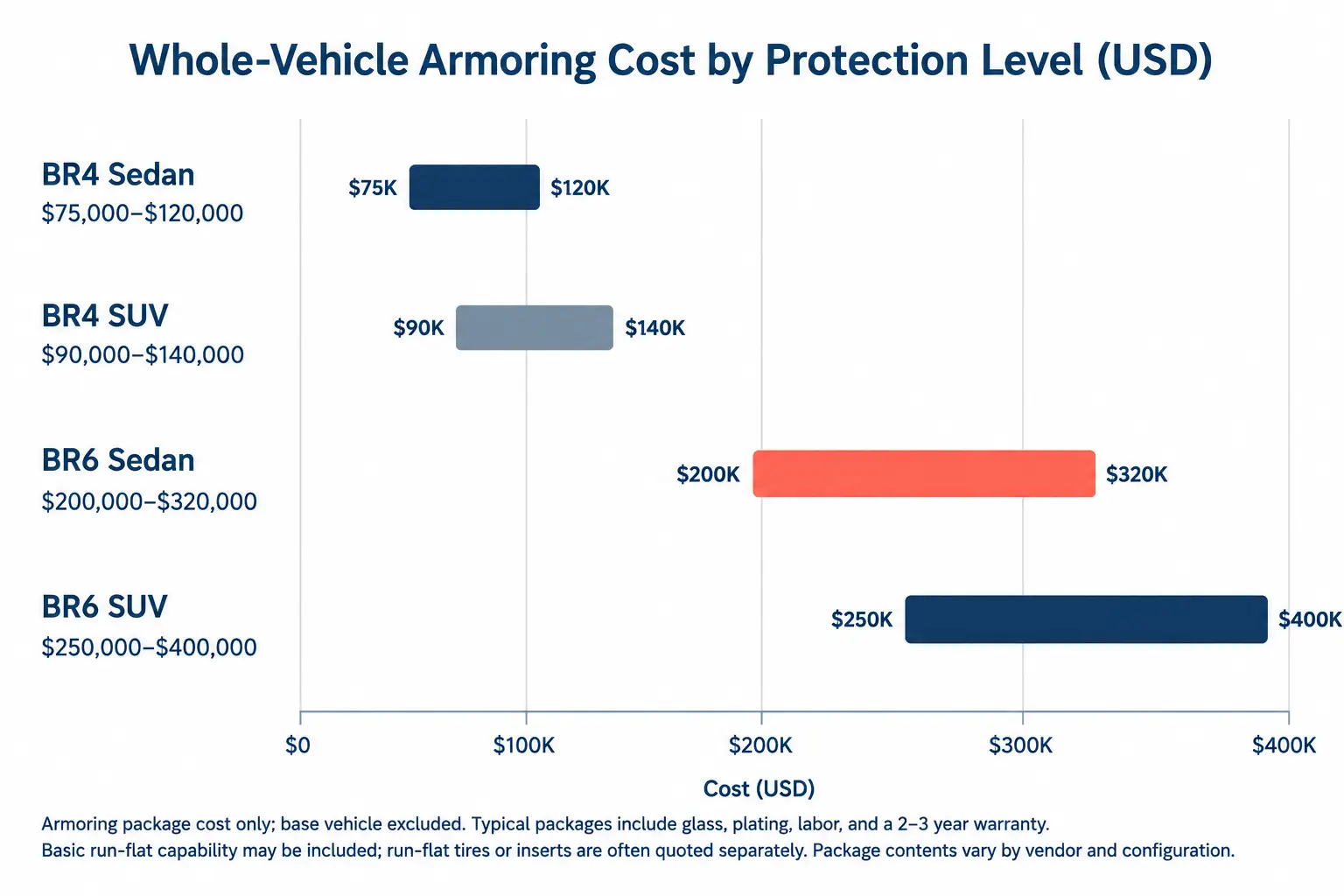
Reputable armoring firms quote integrated packages that include glass, plating, suspension upgrades, labor, testing, and warranty. These are the honest reference points for MOFU decision-makers. Whole-vehicle quotes typically run:
- BR4 sedan: $75,000–$120,000 USD (includes glass, Kevlar/composite plating, basic run-flat upgrade, labor, 2–3 year warranty)
- BR4 SUV: $90,000–$140,000 USD
- BR6 sedan: $200,000–$320,000 USD (includes all BR4 elements plus structural steel, suspension reinforcement, extended labor)
- BR6 SUV: $250,000–$400,000 USD
The package approach is transparent: you know what you're paying for. Component-level shopping invites cost creep—customers often underestimate integration expenses and end up 20–40% over budget. For a complete guide to civilian vehicle armoring, see Civilian Vehicle Armoring: A Complete Guide to Protection Levels, Costs, and the Process.
Regional Differences: US vs South Africa
Geographic arbitrage significantly impacts armoring costs, driven by labor rates, import tariffs, threat environment specialization, and OEM partnerships.
United States Market
US armoring prices reflect high labor costs ($150–$250 USD per hour) and a fragmented vendor ecosystem. Alpine Armoring and IAG (Integrated Armor Group) dominate the federal/diplomatic segment; smaller regional shops serve private clients. Pricing is generally 20–40% higher than South African equivalents on a per-unit basis, though the US market benefits from OEM partnerships (Ford, Chevrolet) that reduce production delays and warranty complications.
A BR4 mid-size sedan conversion in the US runs $85,000–$130,000 USD. A BR6 equivalent starts at $200,000 USD and scales to $400,000+ USD for luxury platforms. Premium features (smoke screens, fire suppression, ballistic seats) add $10,000–$40,000 USD per feature.
Whole-vehicle pricing in the US market also reflects base-vehicle cost: a BR4 Toyota Camry conversion totals approximately $95,000–$135,000 USD (Camry MSRP ~$30,000 + $65,000–$105,000 armoring); a BR6 Escalade ESV approaches $450,000–$520,000 USD total ($80,000–$100,000 ESV + $370,000–$420,000 armoring).
South African Market
South Africa's armoring industry is mature, specialized, and concentrated around three major firms (SVI Engineering, Armoured Mobility, Armormax). The competitive landscape has driven BR4 conversion costs down dramatically. Current pricing:
- BR4 sedan: R690,000–R720,000 ZAR (~$38,000–$40,000 USD)
- BR4 SUV (medium): R659,900–R850,000 ZAR (~$36,000–$47,000 USD)
- BR6 sedan: R1,400,000+ ZAR (~$77,000+ USD)
- BR6 SUV (medium): R1,180,000–R1,450,000 ZAR (~$65,000–$80,000 USD)
A critical observation: South African BR4 pricing is 40–50% cheaper than US equivalents, primarily because local labor is lower-cost and the market is hyper-competitive. However, this advantage vanishes for BR6—South African BR6 conversions command near-US pricing because engineering complexity and material scarcity create similar cost floors globally.
Recent market developments: SVI Engineering launched "SVI Lite" in 2025, offering partial B2 protection (9mm handgun, side doors only) for R219,800 ZAR (~$12,000 USD), targeting mainstream buyers priced out of full BR4 packages. This tier-two option signals market maturation and affordability pressure.
OEM partnerships are standard in South Africa. Ford Everest, Toyota Land Cruiser, and other popular platforms offer factory-approved BR4/BR6 packages through dealerships, preserving manufacturer warranties and simplifying financing. For specific platform details, see Armored Toyota Land Cruiser: Glass, Armor, and What Changes, Armored BMW X5: Protection Options and Tradeoffs, Armored Mercedes G-Class: Armoring a Body-on-Frame Luxury SUV, and Armoured Toyota Hilux: Workhorse Armoring in South Africa.
What Is Often Quoted Separately
Armoring vendors frequently quote components separately, creating confusion over "all-inclusive" pricing. Savvy buyers need to ask specifically what is and isn't included.
Typically Included in Core Armoring Quotes:
- Ballistic glass (all windows, often including sunroof)
- Body plating and structural reinforcement
- Installation labor
- Basic run-flat capability or tire upgrade option
- Paint/finish restoration
- Basic testing and certification documentation
- 2–3 year parts/labor warranty
Often Quoted Separately (Confirm Before Committing):
- Run-flat tires or inserts (frequently a line item; $1,400–$6,000 USD)
- Advanced driver-assistance system (ADAS) recalibration ($2,000–$5,000 USD for modern vehicles with sensor integration)
- Roof and floor armor (additional $1,500–$5,000 USD depending on protection level)
- Custom paint or interior color matching ($500–$2,000 USD)
- Transportation and logistics ($500–$2,000 USD)
- Optional security features (PA systems, ballistic seats, gun ports, emergency escape hatches) ($5,000–$30,000+ USD per feature)
The most common surprise cost is ADAS recalibration. Modern vehicles rely on front-windscreen-mounted cameras and radar for lane-keeping, collision avoidance, and adaptive cruise control. Thick ballistic glass refracts light differently, degrading sensor performance. Recalibration requires specialized equipment and often a visit to the OEM dealer—costs and timelines frequently blindside buyers who assumed "glass replacement" was straightforward.
Glass-Level Pricing Note: Ballistic glass is a natural funnel point for component-level inquiry. Handgun-grade glass (19–21mm) costs significantly less than rifle-grade (38–72mm), and many customers explore "glass upgrade" scenarios separately from structural plating. This is where BallisticBuddy's expertise becomes valuable: we supply custom-curved, OEM-specification ballistic glass for specific vehicle platforms, and our glass technical library routes customers toward the right thickness/composition for their threat profile. For standard configurations, we can provide glass samples and detailed cost breakdowns, then work with armoring integrators on installation logistics. You can order a test sample to verify protection yourself.
FAQ: What You're Actually Paying For
Q: Why does bulletproof glass cost so much more than regular automotive glass?
A: Ballistic glass is a laminate of optical polycarbonate, acrylic, and adhesive layers engineered to absorb and disperse impact energy. A single 38mm rifle-grade panel requires 8–12 material layers and precision optical alignment. Manufacturing tolerances are 0.1mm; defect rates are 15–25%. A standard automotive windscreen costs $200–$800 USD; ballistic equivalent costs $3,000–$8,000+ USD. The raw material cost is only 20–30% of the price; the remainder is engineering, precision tooling, and quality control. See our Test Results & Reports for verification data.
Q: Do I really need 360-degree protection, or can I armory just the cabin?
A: Full 360-degree protection is recommended for all threat levels. Underprotected zones (roof, floor, rear panels) have proven vulnerable to secondary threats—follow-up shots, ricochets, or attacks from unexpected angles. However, partial protection (side doors only, like SVI Lite) is a legitimate entry-level choice for low-threat urban environments. Clarify your actual threat scenario with your installer; don't assume you need maximum protection. For more on threat assessment, see Vehicle Shooting Protection: What to Do If Your Car Is Shot At and Carjacking Prevention: How to Avoid It and What to Do If It Happens.
Q: Can I retrofit armoring to any car?
A: Technically, yes—structurally, no. Vehicles under 2,800 lbs curb weight or with unibody frames may struggle to absorb armoring weight and structural modifications. BR4 retrofits are feasible on most sedans and compact SUVs; BR6 retrofits require body-on-chassis platforms (pickup trucks, large SUVs, Jeeps) to remain road-legal. Ask your installer for weight calculations and gross vehicle weight rating (GVWR) analysis before committing. See Can You Bulletproof a Car? What Is Possible on a Normal Vehicle and How to Bulletproof a Car: Materials, Levels, and the Build Process.
Q: How much does insurance cost for an armored vehicle?
A: Insurance premiums for armored vehicles run 15–40% higher than stock equivalents, depending on the insurer's threat assessment and your location. In the US, expect $1,200–$2,500 annually for comprehensive coverage on a BR4 vehicle; BR6 vehicles may hit $2,000–$3,500+. South African insurers sometimes offer modest reductions for BR4 (due to hijacking-theft prevention), but BR6 may attract higher premiums. Always disclose armoring to your insurer; undisclosed modifications can void coverage.
Q: What's the resale value of an armored vehicle?
A: In South Africa, armored vehicles hold value exceptionally well—60–80% of conversion cost is recoverable after 3–5 years due to high civilian demand. US resale is more fragmented; buyers are fewer, and resale value depends heavily on threat environment and buyer profile. Federal agencies and diplomats actively buy used armored vehicles; private buyers are scarcer. Expect 40–60% value recovery in the US after 5 years. For buying guidance, see Bulletproof Cars for Sale: How Civilian Buyers Actually Buy One and Best Bulletproof Cars: How to Judge Protection Instead of Marketing.
Q: How long does an armoring conversion actually take?
A: BR4 conversions typically require 4–8 weeks; BR6 conversions 8–16 weeks. Custom curved glass adds 2–4 weeks; OEM sensor recalibration adds 1–2 weeks. Reputable firms provide detailed timelines upfront. Rush jobs (sub-6 weeks for BR6) are red flags—they correlate with poor quality control and warranty issues.
Q: Are there cheaper alternatives to full armoring?
A: Yes. Security window film (polyester laminate) costs $500–$2,000 USD per window and provides smash-and-grab protection but zero ballistic resistance. Ballistic panels for specific zones (doors only) cost 30–50% less than full conversions. SVI Lite and similar partial-protection tiers now offer affordable BR2–B4 entry points. However, none of these alternatives match full armoring's comprehensive protection; they're stopgaps for specific, low-threat scenarios. For evaluating armoring providers, see Armored Car Companies Compared: How to Evaluate an Armoring Provider.
The Real Cost Equation
Bulletproof car pricing appears chaotic because it is genuinely complex—protection level, vehicle type, material science, regional labor, and threat environment create legitimate variance. However, the structure is predictable once you disaggregate the drivers.
A realistic budget:
- Handgun protection (BR4): Expect $75,000–$130,000 USD total armoring cost on a mid-size sedan ($30,000–$35,000 base vehicle = $105,000–$165,000 total ownership)
- Rifle protection (BR6): Budget $200,000–$400,000 USD total armoring cost on a comparable platform ($235,000–$435,000+ total ownership)
- Premium vehicles or maximum protection: $400,000–$600,000+ USD
Hidden ownership costs (often underestimated):
- Insurance: +$500–$1,500 USD annually
- Maintenance: +$2,000–$8,000 USD annually (specialized shops, specialized parts)
- Fuel: +10–25% consumption, equivalent to $1,000–$3,000 USD annually depending on driving patterns
What changes the equation:
- OEM partnerships reduce timelines and preserve warranties (net savings: 5–15% on total cost + reduced resale friction)
- Composite materials vs. steel reduce weight but increase upfront glass cost (often net-neutral over 5-year ownership)
- Partial protection (doors-only, side panels) cuts armoring costs 40–60% but leaves vulnerability windows
The MOFU buyer asking "how much does it cost" is usually making a high-stakes personal security decision. The right answer isn't a number—it's understanding that you're buying a system, not a commodity. Glass component quality, structural integration rigor, and installer expertise matter as much as tonnage of steel. BallisticBuddy's role is ensuring that customers get precise glass specifications, transparent component sourcing, and integration guidance that prevents costly retrofit delays and warranty complications. Learn more About Us or Contact Us for a consultation.
Sources
Alpine Armoring USA, "Bulletproof Car Costs: 2026 Price Guide," 2026 SILATEC Bulletproof Glass, "How much does bulletproof glass cost?" N/A Clear Armor, "How Much Does Bulletproof Glass Cost?," 2024 Accio, "Ultimate Guide to Bullet-Resistant Glass Prices: Market Trends, Types, and Smart Buying Tips," N/A USVSG, "Flatsover High Performance Run-Flat Insert," N/A BusinessTech, "How much it costs to bullet-proof your car in South Africa in 2024," 2024 TopAuto, "What a set of bulletproof wheels costs in South Africa – And how they work," 2024 Armormax / Armoured Mobility, "How much does it cost to Armour your Vehicle?," 2024 CAR Magazine, "Stop That Bullet! The Rise of Armoured Vehicles in SA," 2024 Cost Insider, "Bulletproof Tire Cost Guide," 2026
Next Steps for MOFU Readers:
This article addresses whole-vehicle intent and decision hurdles. For component-level deep dives:
- Glass specifications by protection level → Ballistic Vehicle Glass Cost Guide (internal pillar link)
- Run-flat tire selection & sourcing → Contact BallisticBuddy for vehicle-specific samples and technical specifications
- Regional supplier comparison & project planning → Request a consultation for OEM-specification glass and integration timeline estimates