BallisticBuddy logo
Productos
Por qué probado
Herramientas
Blog
Muestras de prueba
Acerca de
Contacto

BallisticBuddy

Producción

Todos los productos

Vidrio balístico para vehículos

Neumáticos antibalas

Investigación y pruebas

Muestras de prueba

Recursos

Herramientas gratuitas

Blog

Guías de vidrio para vehículos

Guías de blindaje de vehículos

Guías de neumáticos antibalas

Empresa

Acerca de

Contacto

Política de privacidad

Términos de servicio

Obtener una cotización

Indícanos el vehículo y el nivel de amenaza — te enviaremos una especificación y una cotización.

Ideas y Perspectivas

Vehicle Armoring

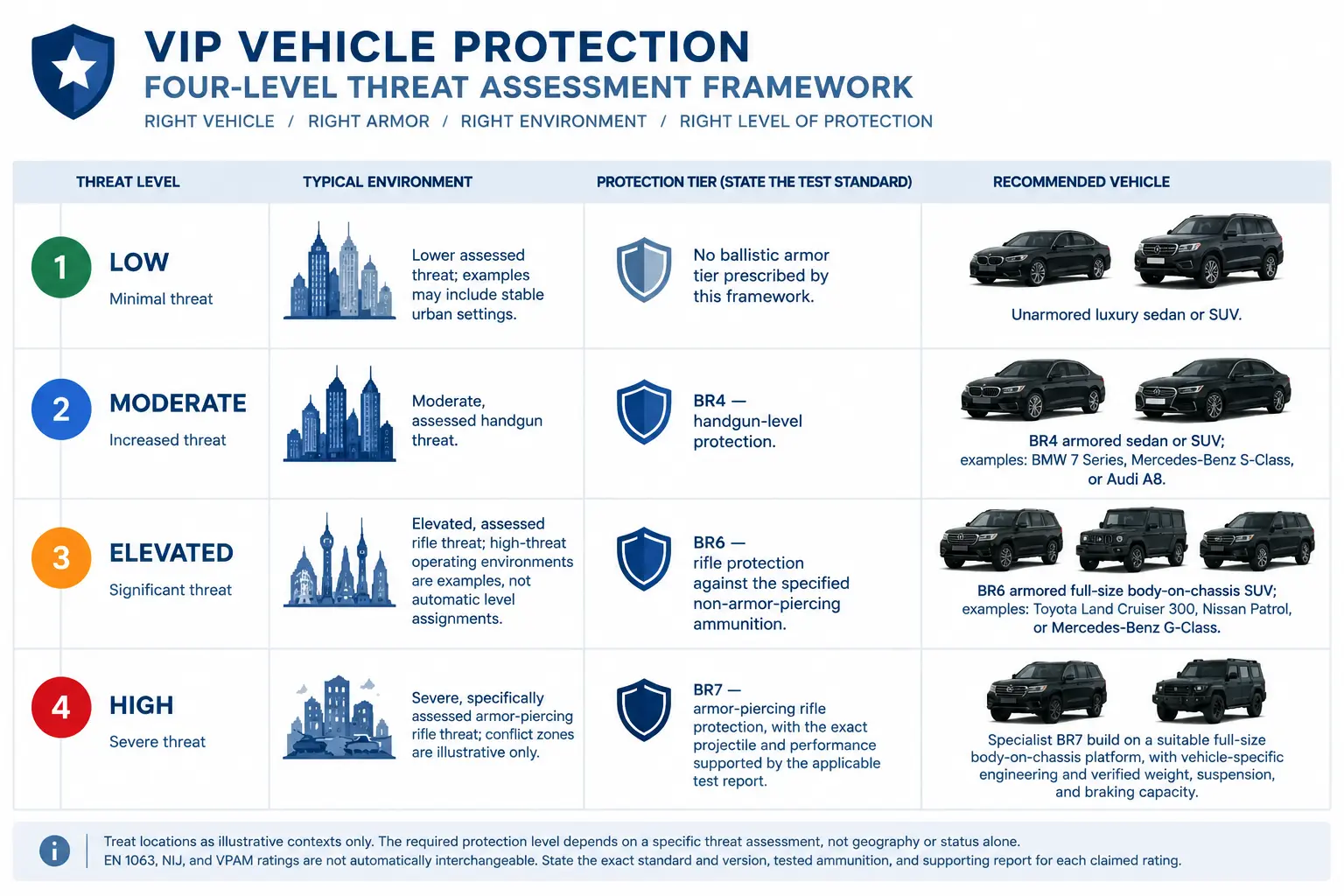
Armoring a vehicle starts with a simple question: what threat are you actually protecting against? The answer decides almost everything that follows — the protection level, the materials, the weight you are willing to carry, and the paperwork you will need where you live. This is the main entry point for civilian vehicle armoring. The articles below walk the full path from that first decision to a delivered vehicle: how a car is actually armored and how long it takes, how armor levels are rated and what each one stops, how body panels and glass are specified together, how added weight changes braking and handling, what is legal and what requires special licensing, and how to evaluate an installation partner before you hand over a vehicle. Most readers arrive with one of three questions. Can a normal car be armored at all? How much does it cost, and what drives the price? Is it legal where I drive? Each has a dedicated article in this cluster, and each links back to the others so you can move between the practical, the financial, and the legal view without losing your place. If you are completely new to the topic, start with the pillar guide for the full picture. If you already know your requirement, go straight to the article that matches your situation — level selection, cost, installation logistics, or legality.

Artículo Destacado

Blindaje de vehículos civiles: Guía completa sobre niveles de protección, costos y proceso

miércoles, 28 de octubre de 2026

/

Vehicle Armoring

/

1 min. de lectura

Blindaje de vehículos civiles: Guía completa sobre niveles de protección, costos y proceso

Una guía completa sobre el blindaje de vehículos civiles: evaluación de amenazas, niveles de protección BR4/BR6/BR7, plataformas vehiculares, vidrio y neumáticos run-flat, costos, cronograma de construcción y cómo verificar a un proveedor con informes de pruebas de terceros y muestras pagadas.

Leer Artículo

Más Para Leer

Artículos Relacionados

11 nov 2026

/

Vehicle Armoring

/

1 min. de lectura

Armored Mercedes G-Class: Armoring a Body-on-Frame Luxury SUV

Armored Mercedes G-Class engineering guide: BR4–BR7 protection levels, 25–43 mm ballistic glass, 420–1,050 kg weight penalties, and the suspension, braking and rollover tradeoffs.

Leer Artículo

10 nov 2026

/

Vehicle Armoring

/

1 min. de lectura

Armored BMW X5: Protection Options and Tradeoffs

Armored BMW X5 engineering guide: 25–43 mm ballistic glass, B4–B7 protection levels, 380–880 kg weight penalties, and suspension, braking and payload tradeoffs.

Leer Artículo

9 nov 2026

/

Vehicle Armoring

/

1 min. de lectura

Is It Legal to Bulletproof a Car? Rules by Country

Yes—bulletproofing a car is legal for civilians in the US, Canada, UK, EU, South Africa, and most free-market democracies. Here are the real limits: GVWR and axle loadings, 70% VLT glass rules, export controls, permits, and specialty insurance requirements by country.

Leer Artículo

8 nov 2026

/

Vehicle Armoring

/

1 min. de lectura

Bulletproof Cars for Sale: How Civilian Buyers Actually Buy One

How civilian buyers actually acquire a bulletproof car: turn-key versus component builds, the mechanical risks hiding in used armored stock, pre-purchase verification steps, ballistic level reference, and regional procurement rules.

Leer Artículo

3 nov 2026

/

Vehicle Armoring

/

1 min. de lectura

¿Cuánto cuesta el vidrio balístico para un automóvil?

El costo del vidrio balístico para un automóvil depende del nivel de protección, el tamaño del vidrio, la curvatura, la construcción laminada y la complejidad de la instalación, no solo del tamaño del vehículo o del grosor.

Leer Artículo

2 nov 2026

/

Vehicle Armoring

/

1 min. de lectura

How Much Does It Cost to Bulletproof a Car?

Bulletproofing a car starts at $75,000–$90,000 USD for handgun protection, while rifle-resistant armor ranges from $170,000–$320,000 USD depending on vehicle and threat level.

Leer Artículo

1 nov 2026

/

Vehicle Armoring

/

1 min. de lectura

Armored Car Companies Compared: How to Evaluate an Armoring Provider

Evaluate armoring providers using this framework: vertical integration vs. component sourcing, in-house glass manufacturing advantages, certification vs. test report distinctions, and a non-negotiable pre-signing checklist covering ballistic testing, glass sourcing, and warranty coverage.

Leer Artículo

28 oct 2026

/

Vehicle Armoring

/

1 min. de lectura

Лучшие бронеавтомобили: как оценивать защиту, а не маркетинг

Лучший бронеавтомобиль определяется проверяемыми сертификатами тестов, прозрачными спецификациями стекла и правильной интеграцией, а не маркетингом.

Leer Artículo

28 oct 2026

/

Vehicle Armoring

/

1 min. de lectura

SUVs Blindados: Qué Hace la Blindadura a un SUV y Cómo Elegir Uno

Los SUVs blindados añaden 800-1,200 lbs de protección que afecta el frenado y la manipulación, lo que hace que la selección de la plataforma—diseño body-on-frame y capacidad de carga útil—sea crítica para la seguridad.

Leer Artículo

28 oct 2026

/

Vehicle Armoring

/

1 min. de lectura

How to Bulletproof a Car: Materials, Levels, and the Build Process

Bulletproofing a car is a five-step engineering rebuild, not a simple upgrade. It involves threat assessment, integrated ballistic glass and body armor, and run-flat systems, taking 8–14 weeks.

Leer Artículo

28 oct 2026

/

Vehicle Armoring

/

1 min. de lectura

¿Puedes blindar un coche? ¿Qué es posible en un vehículo normal

Los vehículos civiles pueden ser reformados con protección balística, pero la capacidad de peso limita su viabilidad. Los SUV medianos y camiones son ideales; los coches compactos enfrentan compensaciones estructurales y de garantía.

Leer Artículo
Página SiguienteTodas las Otras Categorías