
Yes, you can bulletproof a normal car, but it requires comprehensive modifications and comes with tradeoffs you need to understand upfront. The short answer: most civilian vehicles can be retrofitted with ballistic protection, though the process is intensive, the weight penalties are real, and the level of protection you choose directly determines cost, performance impact, and daily usability.
Short Answer: What Can and Cannot Be Armoured
Bulletproofing a production car is technically feasible for the vast majority of platforms. Dedicated armoring firms successfully retrofit everything from compact sedans to full-size SUVs and trucks. What makes the difference is not whether a vehicle can be armored, but whether it should be given its weight capacity and intended use.
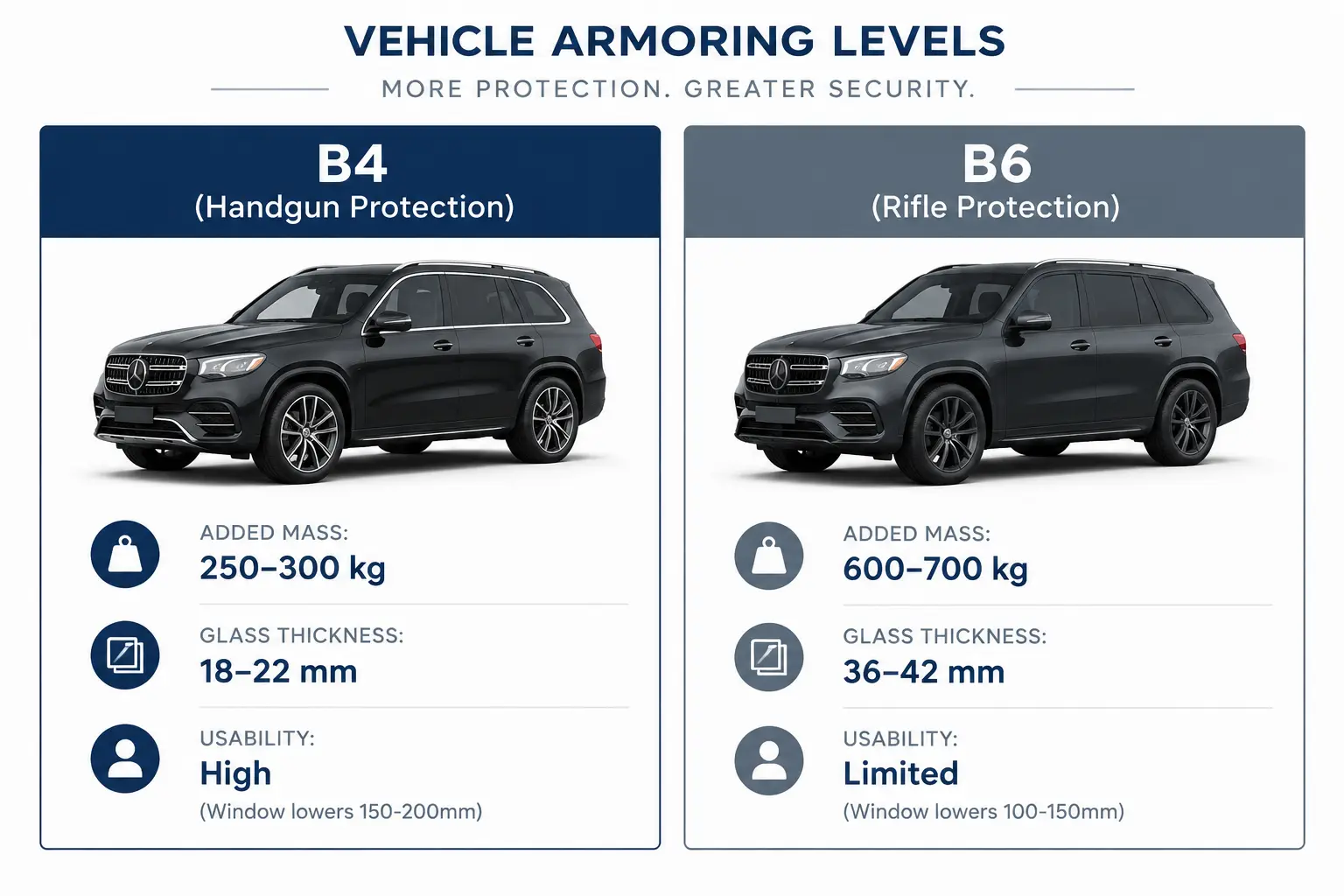
The core constraint is the gross vehicle weight rating (GVWR). A B4 handgun-protection conversion adds roughly 250–300 kg; B6 rifle-level protection adds 600–700 kg. If the added mass pushes the vehicle over its GVWR, the drivetrain, suspension, and brakes all suffer accelerated wear, and the manufacturer's warranty typically voids. This problem most frequently occurs with lighter unibody sedans and compact crossovers. A Toyota Fortuner or Land Cruiser, by contrast, is purpose-built to absorb that penalty because their body-on-chassis architecture and heavier suspension can handle it without modification.
What cannot be economically or safely armored includes:
- Subcompact hatchbacks and economy sedans under 1,400 kg kerb weight (structural integrity compromised, resale value collapses)
- Aluminum-bodied vehicles without specialized engineering (aluminum won't accept traditional steel welding; composite solutions cost substantially more)
- Vehicles already near or at GVWR before armoring
The practical sweet spot remains mid-size to full-size SUVs, pickup trucks with crew cabs, and executive sedans (BMW 7-Series, Mercedes S-Class, Audi A8 range).
Which Vehicles Are Practical to Armour
Body-on-chassis vehicles (most practical):
Double-cab pickup trucks, ladder-frame SUVs like the Toyota Land Cruiser 300, Nissan Patrol, and Mercedes-Benz G-Class are industry favorites because their separate frame and suspension can absorb added mass without redesign. A B6 conversion on a Toyota Land Cruiser 300 requires suspension and door-hinge upgrades, but the vehicle remains usable for daily driving. These platforms complete conversion in 8–12 weeks with predictable outcomes because the engineering is repeatable.
Unibody sedans and luxury vehicles (feasible but compromised):
A BMW 7-Series or Mercedes S-Class can be armored at B4 level (handgun) with minimal structural modification because the mass penalty (~280 kg) is modest relative to the vehicle's 1,900+ kg kerb weight. However, B6 rifle-level protection on a unibody platform introduces engineering risk—the monocoque shell wasn't designed to carry localized armor stresses, and specialist firms like SVI deliberately avoid B6 conversions on luxury sedans for this reason.
Armored BMW X5: Protection Options and Tradeoffs
Mid-size SUVs (balanced choice):
Vehicles like the Toyota Fortuner or Mahindra Scorpio occupy the practical center. A B4 conversion adds 260 kg to a Fortuner with a 2,610 kg GVWR, leaving 750 kg of headroom. No suspension or drivetrain upgrade is necessary. The interior remains nearly stock. Driver window operation is only slightly restricted. Resale takes a modest hit compared to unarmored examples, but not catastrophic.
Vehicles to avoid:
Anything with aluminum bodies (Range Rover Evoque, all-aluminum Jaguar Land Rover models) requires specialized composite armor because you cannot weld steel to aluminum—the metallurgical mismatch causes structural failure. The cost penalty is 30–50% higher than steel-armored equivalents, and the engineering turnaround extends to 12–16 weeks.
Turnaround is fastest (6–8 weeks) for vehicles the shop has armored multiple times; first-time platforms add 4–6 weeks of design and fixture fabrication.
Armoured Toyota Hilux: Workhorse Armoring in South Africa
What the Process Involves
Phase 1: Disassembly and Engineering (2–4 weeks)
The entire interior is stripped—seats, trim panels, wiring harnesses, carpet, instrument cluster. The vehicle is then subjected to 3D coordinate measurement to create digital templates of every surface that will receive armor. Simultaneously, structural engineers run finite-element analysis on the chassis to confirm that added mass does not exceed GVWR and that stress points (door hinges, suspension mounts, firewall) can handle the new loads. This design phase is critical. Rushing it results in ballistic gaps, misaligned glass, or door mechanisms that fail under the extra weight.
Phase 2: Armor Component Manufacturing (2–4 weeks, parallel)
Ballistic glass is ordered to OEM spec—exact curve, heating elements, antenna integration, and tint. Kevlar sheets (for B4 body panels) or steel plates (for B6) are cut to template. Window-lift motors are sourced or upgraded because 25–43 mm ballistic glass weighs 8–20 kg per pane versus 2–3 kg for factory glazing.
How to Bulletproof a Car: Materials, Levels, and the Build Process
Phase 3: Installation and Integration (2–3 weeks)
Doors and pillars are opened to receive ballistic materials. Kevlar layers are glued into cavities; steel plates are welded to firewall and rear bulkhead. The ballistic glass is fitted—this is the most time-consuming step because curvature and thickness must be perfect, and any thermal stress during installation triggers cracking or delamination. Once glass is set, interior panels are refitted (modified because they must fit around thicker window perimeters). Airbags, seat sensors, and electrical harnesses are reinstalled in factory positions. Run-flat tire inserts are fitted inside the wheel wells.
Phase 4: Quality and Testing (1–2 weeks)
Rain-seal testing ensures no water intrusion around the new glass seals. A 300+ km road test checks for rattles, squeaks, and any systems interference. If the conversion is to be certified, the vehicle is sent to an independent ballistic test range where 28 rounds are fired per vulnerability zone—typically eight zones on the passenger compartment. For BallisticBuddy test-verified specifications, conversions pass EN 1063 and NIJ protocols with no penetrations into the passenger cell, confirming that proper installation eliminates weak points.
Common Real-World Adjustment:
Armoring firms often discover late in the build that electrical harnesses or mechanical linkages cannot be fully protected without compromising vehicle function (the firewall is a frequent culprit). Engineering then selects the next-best coverage, which is why certified vehicles may have coverage of 95–98% rather than 100%. This is not failure—it is reality. The test protocol allows up to three penetrations across all zones before the conversion is deemed failed; modern shops rarely exceed one.
Armored Car Companies Compared: How to Evaluate an Armoring Provider
What It Costs and How Long It Takes
Cost bands (2026 market, BallisticBuddy component data):
Protection Level | Vehicle Class | Added Mass | Typical Mass Addition | Ballistic Glass Thickness | Turnaround | Notes |
|---|---|---|---|---|---|---|
B4 (handgun) | Mid-size SUV or sedan | 250–300 kg | Within GVWR | 18–22 mm | 8–10 weeks | No suspension upgrade; driver window still opens; minimal resale impact |
B4 (handgun) | Pickup truck | 250–300 kg | 2–4% of GVWR | 18–22 mm | 8–10 weeks | Fastest, most predictable conversion |
B6 (rifle) | Full-size SUV or truck | 600–700 kg | 8–12% of GVWR | 36–42 mm | 10–14 weeks | Suspension/brake/hinge upgrades; significant daily-use penalty |
B6 (rifle) | Sedan (unibody) | 600–700 kg | Risk of exceeding GVWR | 36–42 mm | Not recommended | Structural integrity concerns; specialist firms decline these |
BallisticBuddy's third-party test report (FDCL-3B-25-BB-I) confirms that 25 mm ballistic glass provides 81.3% light transmission while stopping 9 mm handgun rounds reliably. At the B6 level, the FDCL-4B-36-BB test report documents 36 mm class glass stopping 7.62×51 mm steel-core rifle fire with no spall and 78.9% transmission—a 3–4% loss in visibility that becomes noticeable at night. For 43 mm B6+ configurations (FDCL-5B-43-BB-I), transmission remains at 82.4%, meaning thicker glass does not always mean more light loss if the material stack is engineered correctly.
The cost differential between B4 and B6 is roughly 200–250%, not because materials are three times more expensive but because B6 requires structural upgrades (suspension, hinges, brakes), ballistic steel welding (versus Kevlar gluing), and extended engineering validation. A B4 conversion on a Toyota Fortuner typically costs 30–40% less than the same vehicle at B6.
Hidden costs to budget for:
- Replacement ballistic glass after damage: 3–5x the cost of OEM glass
- Fuel economy penalty: 8–15% worse for B4, 15–25% worse for B6
- Insurance may require higher premiums; some insurers decline armored vehicles entirely
- Resale value: B4 conversions retain 60–75% of conversion cost; B6 retains 40–60%
How Much Does It Cost to Bulletproof a Car?
What Level of Vehicle Armour Do You Need
BR4 / NIJ IIIA (handgun protection):
Stops 9 mm Parabellum, .357 Magnum, and .44 Magnum at point-blank range. Requires 18–24 mm ballistic glass. In assessments of real-world incidents in South Africa and Latin America (where armored vehicle data is extensive), handgun attacks account for ~85% of civilian vehicle crime. Unless you operate in an active conflict zone or transport high-value goods routinely, BR4 is the practical threshold. It adds minimal weight, requires no suspension modification, and preserves daily usability—the driver's door window can lower 150–200 mm, enough to interact with toll booths and security gates.
BallisticBuddy's FDCL-3B-25-BB-I test confirms that 25 mm ballistic glass passes EN 1063 BR4 with 81.3% optical clarity. Handgun-level protection is mature technology; failure rates in conversion are <1% when installed by certified shops.
Vehicle Shooting Protection: What to Do If Your Car Is Shot At
BR6 / NIJ III (rifle protection):
Stops 5.56×45 mm NATO (M16/AR-15) and 7.62×51 mm (G3/AK-47 soft-core). Requires 36–42 mm ballistic glass. In analyses of high-security escort operations and diplomatic-protection fleets, BR6 conversions make sense only for individuals in active conflict zones, high-profile political figures, or cash-in-transit operations. For civilian executives in stable urban environments, BR6 is often security theater—you are trading 600+ kg of mass, 15–25% fuel economy loss, and restricted window operation for protection against a threat that is statistically unlikely in your geographic area.
However, if you operate in Nigeria, parts of Mexico, or conflict-adjacent regions, BR6 is justified. BR6-armored Land Cruisers in these markets survive ambush scenarios that would penetrate BR4; the statistics are stark enough that the resale-value penalty becomes acceptable.
VIP Vehicle Protection: What Executive Travel Actually Requires
BR7 and beyond (armor-piercing rifle):
Requires 55–80 mm glass and structural steel plating. Reserved for military, law enforcement, or high-net-worth individuals in extreme-threat environments. Not practical for civilian daily-use vehicles—doors become too heavy to open conveniently, window operation is severely limited, fuel economy drops 25–35%, and the vehicle handles like a tank. Cost is 3–4x that of BR6.
Decision framework:
- Low-risk environment (developed urban/suburban): BR4 is sufficient; attack is rare.
- Moderate-risk (known threat history, high-value cargo): BR6 justified; cost/benefit shifts in your favor.
- High-risk or combat zone: BR7 or specialist military armoring; seek expert threat assessment.
How to Protect Your Vehicle: A Threat-Based Approach
Best Bulletproof Cars: How to Judge Protection Instead of Marketing
Armored Vehicles: A Buyer’s Guide to Levels, Weight, and Fitment
Legality Overview
Armoring a civilian vehicle for personal protection is legal in most jurisdictions, but the rules vary significantly by country and region.
United States: No federal prohibition on private vehicle armoring. States impose no uniform restrictions. However, some jurisdictions require disclosure to insurance and law enforcement; check local statutes. Armored vehicles registered in the US typically undergo ballistic certification to NIJ or UL 752 standards, which provides legal documentation of protection level.
European Union (EN 1063 countries): Armouring is legal; conversions must comply with EN 1063 and often require re-registration. Germany and the UK actively regulate certified armored vehicles; ownership is lawful but may trigger tax or insurance questions. Most EU countries require that you declare the conversion to your insurance company or risk voiding coverage.
South Africa: BR4 armouring is unrestricted. BR6 requires a permit from the National Commissioner of the South African Police Service. BR7 and higher are effectively restricted to government and law enforcement.
Middle East and Africa: Regulations vary by country. Some nations (UAE, Saudi Arabia) permit B4 armouring for executives; others require government approval for any level. Always consult local counsel before ordering a conversion if you operate internationally.
General principle: Armouring itself is not illegal in stable democracies, but undisclosed armouring can void insurance, create liability in accidents (because the vehicle performs differently), and trigger suspicion from law enforcement if stopped. Always:
- Inform your insurance company
- Keep conversion documentation (ballistic test reports, engineering specs)
- Re-register the vehicle if required by local transport authority
- Never represent an armored vehicle as stock; disclose it in any sale
Carjacking Prevention: How to Avoid It and What to Do If It Happens
FAQ: Can a Normal Car Be Bulletproofed / Is It Legal / How Long Does It Take
Q: Can any car be bulletproofed? A: Almost any vehicle can be armored technically, but not every vehicle should be. Weight capacity is the deciding factor. If the added mass (250–700 kg depending on protection level) exceeds the vehicle's GVWR, the drivetrain and suspension will degrade rapidly, and your warranty voids. Mid-size to full-size SUVs and pickup trucks are practical; compact sedans and hatchbacks are not. Aluminum-bodied vehicles require specialist engineering and cost 30–50% more.
Q: How long does it take to bulletproof a car? A: Plan for 8–14 weeks. Disassembly and engineering take 2–4 weeks. Component manufacturing runs in parallel, 2–4 weeks. Installation and integration take 2–3 weeks. Final testing and quality assurance take 1–2 weeks. First-time platforms add 4–6 weeks because fixtures must be fabricated. Turnaround is fastest for vehicles the shop has armored multiple times.
Q: Will my warranty be voided? A: Yes, if conversion weight exceeds GVWR. The vehicle manufacturer will not cover drivetrain, suspension, or brake failures once the vehicle is armored and that added mass is documented. This is not negotiable. Some OEM-approved armoring partnerships (like Volvo's factory armored programs) preserve warranty, but aftermarket conversions do not. Confirm with your insurer before committing.
Q: How much does it cost? A: B4 (handgun) armouring on a mid-size SUV ranges from $40,000–$70,000 USD equivalent. B6 (rifle) runs $100,000–$200,000 USD equivalent. These are ballpark figures; regional pricing, vehicle complexity, and first-time platform status add 20–40%. Exact prices vary significantly by region due to currency fluctuation and labor rates.
Q: Will I notice the weight difference when driving? A: Yes. B4 conversion (250–300 kg added) has minimal impact on acceleration but noticeably reduces fuel economy (8–15% worse). B6 conversion (600–700 kg added) is immediately apparent—acceleration is sluggish, braking requires more distance, and cornering feels heavier. Many owners of B6 vehicles report that city driving feels normal because speeds are low, but highway performance is visibly compromised. This is why driver training is recommended for B6 conversions.
Q: Can I still open my windows? A: Partially, yes—with restrictions. At B4 level, the driver's door window can lower 150–200 mm in most vehicles, enough for toll booths and gate intercoms. At B6 level, window operation is severely limited (often 100–150 mm) because the 36–42 mm glass is so thick that mechanical interference occurs. Passengers' windows typically cannot open at all once armored.
Q: Is the glass clear, or will I see distortion? A: Modern ballistic glass, when properly laminated, is nearly distortion-free. BallisticBuddy third-party test reports confirm that 25 mm handgun-level glass maintains 81.3% optical clarity; rifle-level 36–43 mm glass retains 78.9%–82.4%. The main difference is a slight color shift and reduced brightness at night. This is not the "thick fishbowl effect" of older armor; it is subtle. However, if the lamination is poor or the interlayers are misaligned, double vision and distortion become severe—this is why choosing a certified shop with ballistic test data matters.
Q: Can I retrofit armouring to a specific vehicle I already own? A: Yes, but feasibility depends on the platform. Bring your VIN and the vehicle's GVWR to a certified armoring firm. They will assess whether conversion is practical. If your GVWR leaves less than 300 kg of headroom, armouring will exceed safety limits and the shop may decline. If the vehicle is aluminum-bodied or has complex onboard electronics, cost may be prohibitive.
Q: What if I sell the armored vehicle later? A: Resale is possible but at a discount. B4-armored vehicles retain roughly 60–75% of conversion cost; B6 retains 40–60%. The discount reflects reduced appeal (limited aftermarket, higher insurance, fuel economy penalty) and perceived niche use. A full disclosure of the conversion, ballistic test reports, and maintenance history improve resale prospects. Some buyers specifically seek armored vehicles for security reasons, so niche buyers do exist—but you will not recover the full conversion investment.
Translating Armoring Needs into Component Strategy
For individuals and organizations requiring ballistic protection without full-vehicle retrofit, BallisticBuddy supplies purpose-designed ballistic glass and run-flat tire components that integrate into standard vehicles with minimal modification. Ballistic glass is available in handgun-level (BR4, 20–22 mm) and rifle-level (BR6, 36–42 mm) specifications, each independently certified to EN 1063 standards and tested by accredited ballistic laboratories.
If you are evaluating armoring options, request BallisticBuddy test samples or engineering consultation to confirm that the protection level you require aligns with your threat assessment and vehicle platform. Third-party test documentation provides transparent, reproducible ballistic performance data—critical for decision-making in security-sensitive applications.
For a comprehensive guide to civilian vehicle armoring processes, threat assessment frameworks, and component integration, visit our Civilian Vehicle Armoring Guide.
Armored Vehicle Glass Structure Viewer
Sources
Car and Driver, 2009: How To Bulletproof a Car: Step-by-Step
CAR Magazine, 2018: How a production vehicle is converted into an armoured car
CAR Magazine, 2024: Stop That Bullet! The Rise of Armoured Vehicles in SA
The Drive, 2021: Inside the Bulletproofing Process of Armored Vehicles
Alpine Armoring: Can Any Vehicle Be Bulletproofed?
Integris Composites: Vehicle Armor Protection
Office of Justice Programs: Armoring Patrol Cars — Do the Benefits Outweigh the Costs?
Volvo Cars, 2025: Ready for the Unexpected with Volvo Armoured Cars
Dynamic Defense Solutions: Bulletproof Vehicle Glass Standards
EN 1063 Ballistic Glass Standards and Specifications
SVI Engineering: The Right Level of Vehicle Armour
Isso Armor: Bullet-Proof Glass Levels, Thickness and Vehicle Installation, 2026