
Searching for a bulletproof car for sale immediately brings prospective buyers into an ecosystem of pre-owned luxury SUVs, dealer inventory grids, and specialist up-fitter listings. For private individuals, family offices, and corporate security directors, acquiring an up-armored conveyance is fundamentally different from purchasing a standard production vehicle.
The transaction exists at the intersection of structural engineering, certified ballistic science, and aftermarket chassis integrity. An automobile carrying ballistic steel, composite backing, run-flat devices, and multi-layered transparent armor cannot be appraised solely on odometer readings, interior finish, or model year. How to Bulletproof a Car: Materials, Levels, and the Build Process
Navigating how civilian buyers successfully acquire an up-armored platform, what mechanical and structural risks accompany the pre-owned market, and how certified component procurement shapes long-term fleet survivability is essential before wiring capital. Armored Vehicles: A Buyer's Guide BallisticBuddy designs, tests, and supplies certified vehicle ballistic glass assemblies and heavy-duty run-flat systems directly to licensed up-fitters, commercial coachbuilders, and security fleet operators worldwide. About Us — Factory-Direct Vehicle Protection | BallisticBuddy
What Is Actually Being Sold: Whole Vehicle vs Components?
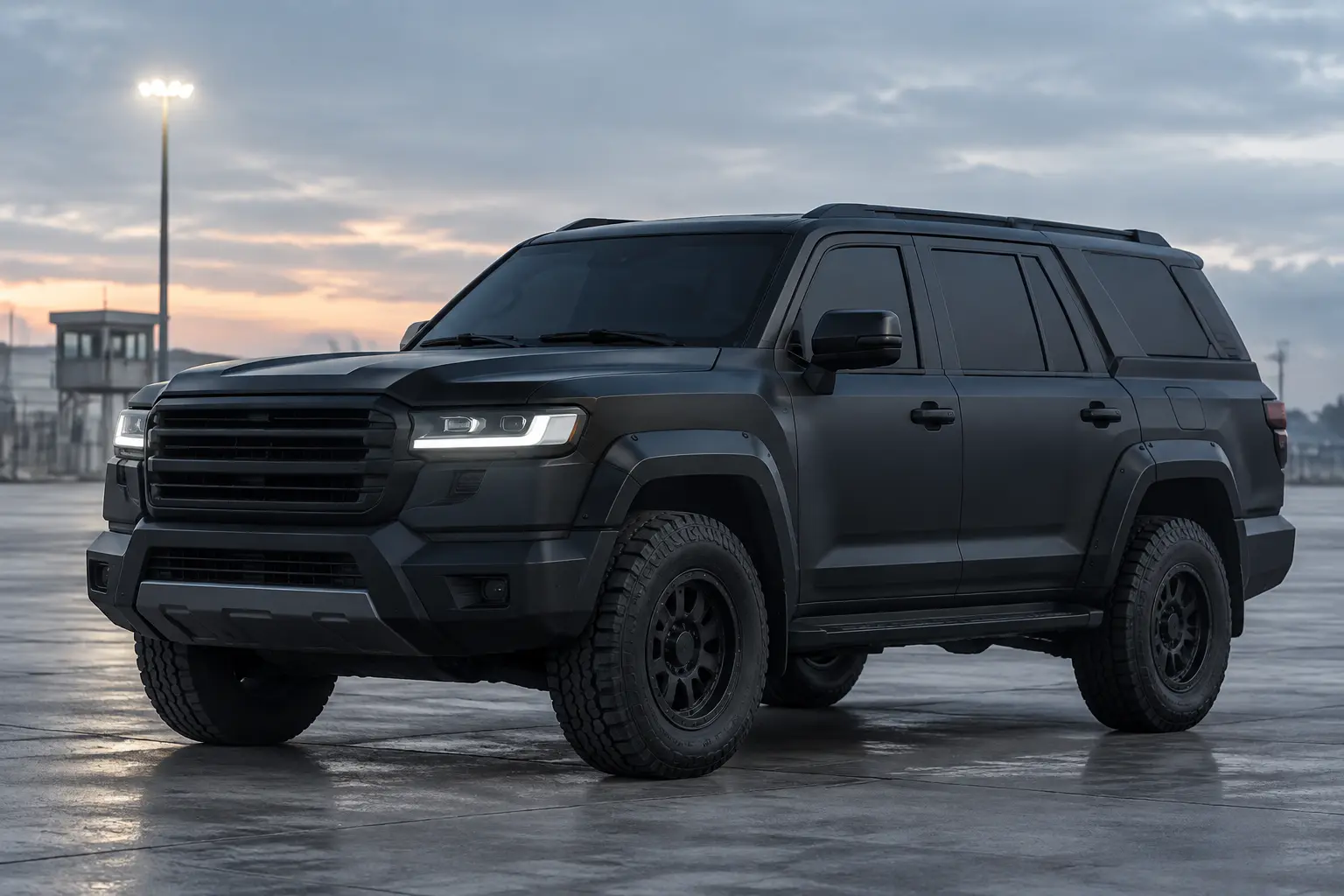
When exploring armored vehicles for sale, prospective buyers navigate two completely separate procurement routes: acquiring a finished turn-key vehicle or commissioning a build through dedicated component integration. Can You Bulletproof a Car? What Is Possible on a Normal Vehicle
In a turn-key transaction, an armoring coachbuilder or commercial broker delivers an assembled vehicle with all ballistic shielding pre-installed. Armored Car Companies Compared: How to Evaluate an Armoring Provider In contrast, an up-fit component procurement model involves purchasing a pristine original equipment manufacturer (OEM) chassis—such as a Toyota Land Cruiser 300, Chevrolet Suburban, or Mercedes-Benz G-Class—and coordinating with an engineering shop that integrates independently certified transparent and opaque armor components built to verifiable standards. Armored BMW X5: Protection Options and Tradeoffs Armored Mercedes G-Class: Armoring a Body-on-Frame Luxury SUV
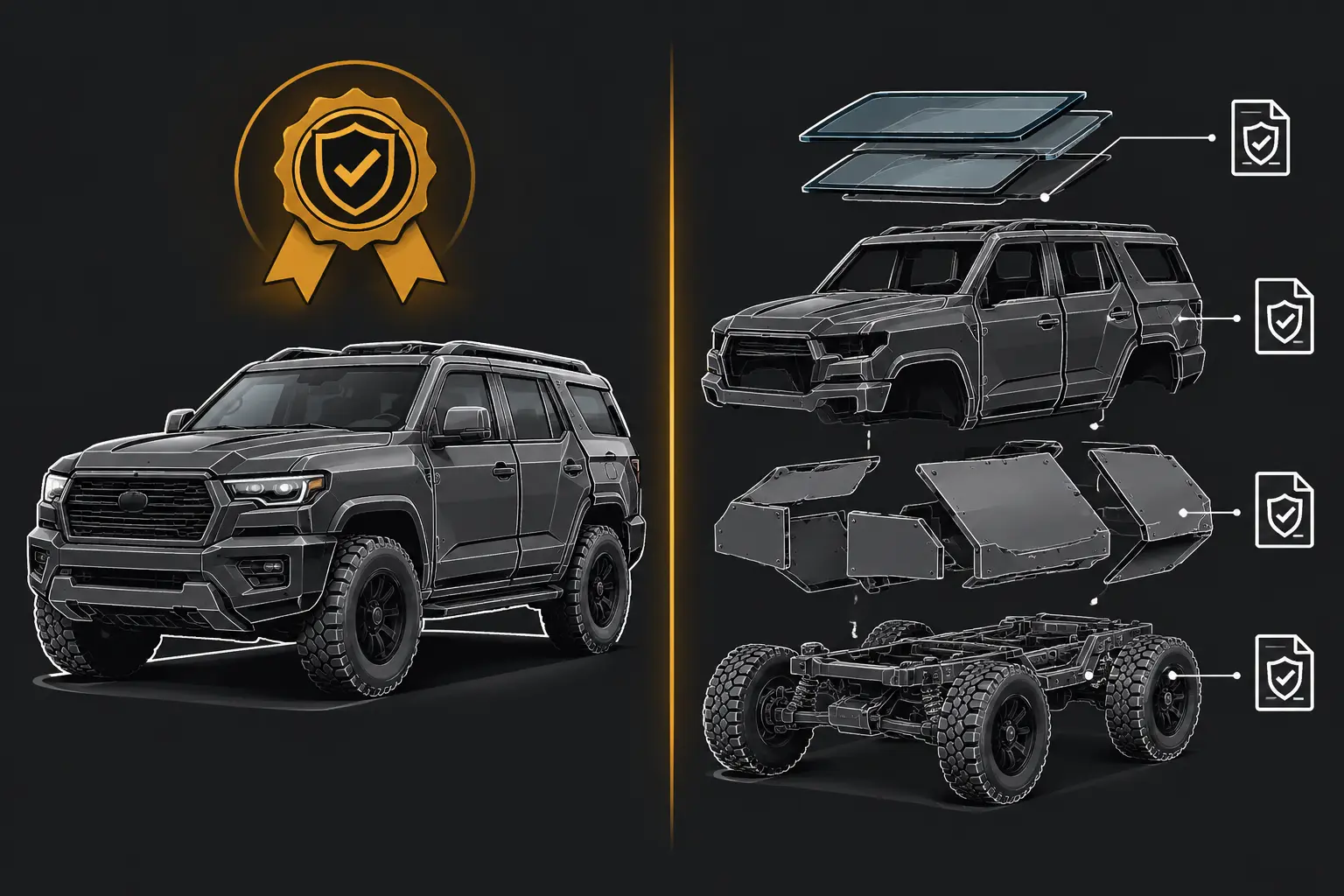
Procurement Parameter | Turn-Key Finished Stock | Component-Driven Custom Build | Operational Impact |
|---|---|---|---|
Delivery Timeline | Immediate delivery (existing lot) to 16 weeks | 10 to 24 weeks based on donor chassis | Pre-built units deploy instantly; custom builds eliminate design compromises |
Material Traceability | Frequently undocumented in secondary stock | Mill test certificates and verified lab tags | Full validation of steel tensile yield and glass lamination recipes |
Ballistic Suitability | Fixed ballistic class (e.g., standard BR4 or BR6) | Tailored transparent thickness (21 mm to 43 mm) | Eliminates carrying unneeded tonnage while preventing under-protection |
Mechanical Baseline | Unrecorded chassis fatigue from static load | Zero-hour OEM factory suspension and drivetrain | Prevents premature suspension sag, bearing failure, and brake fade |
The Difference Between the Conversion and the Base Vehicle
A persistent misstep among first-time buyers is evaluating an armored car for sale exclusively through the lens of its OEM brand badge. An armored SUV is not merely a factory vehicle fitted with thicker windows; it is a mechanical chassis carrying 800 kg to 1,500 kg of continuous static deadweight. Bulletproof SUVs: What Armor Does to an SUV and How to Choose One
The original vehicle manufacturer provides the powertrain, frame rails, and electrical infrastructure, while the armoring conversion constitutes an entirely distinct secondary manufacturing discipline. If the armoring conversion utilized inferior transparent armor susceptible to early delamination, failed to reinforce the pillar hinge geometry, or retained factory-stamped brake calipers, the prestige of the donor marque offers no operational benefit. The client inherits an overloaded vehicle that accelerates mechanical wear and threatens passenger survival during an ambush.
The Role of Independent Component Suppliers
BallisticBuddy does not manufacture or retail finished, complete-vehicle builds. Instead, we operate as a specialized tier-one engineering manufacturer of certified vehicle ballistic glass assemblies and high-performance run-flat systems. Products — Ballistic Glass & Run-Flat Inserts | BallisticBuddy
For commercial buyers commissioning an armoring project, security fleet directors maintaining active convoys, or armoring facilities fulfilling international contracts, sourcing verified transparent armor and run-flat inserts directly ensures component accountability. It guarantees that the glass protecting cabin occupants possesses third-party multi-hit validation under strict ballistic proof protocols rather than relying on unverified assembly-line assertions.
To understand structural chassis dynamics, ballistic classifications, and the engineering trade-offs inherent in passenger platforms, review our civilian vehicle armoring guide.
New, Used, and Pre-Owned Armoured Stock: The Mechanical Realities
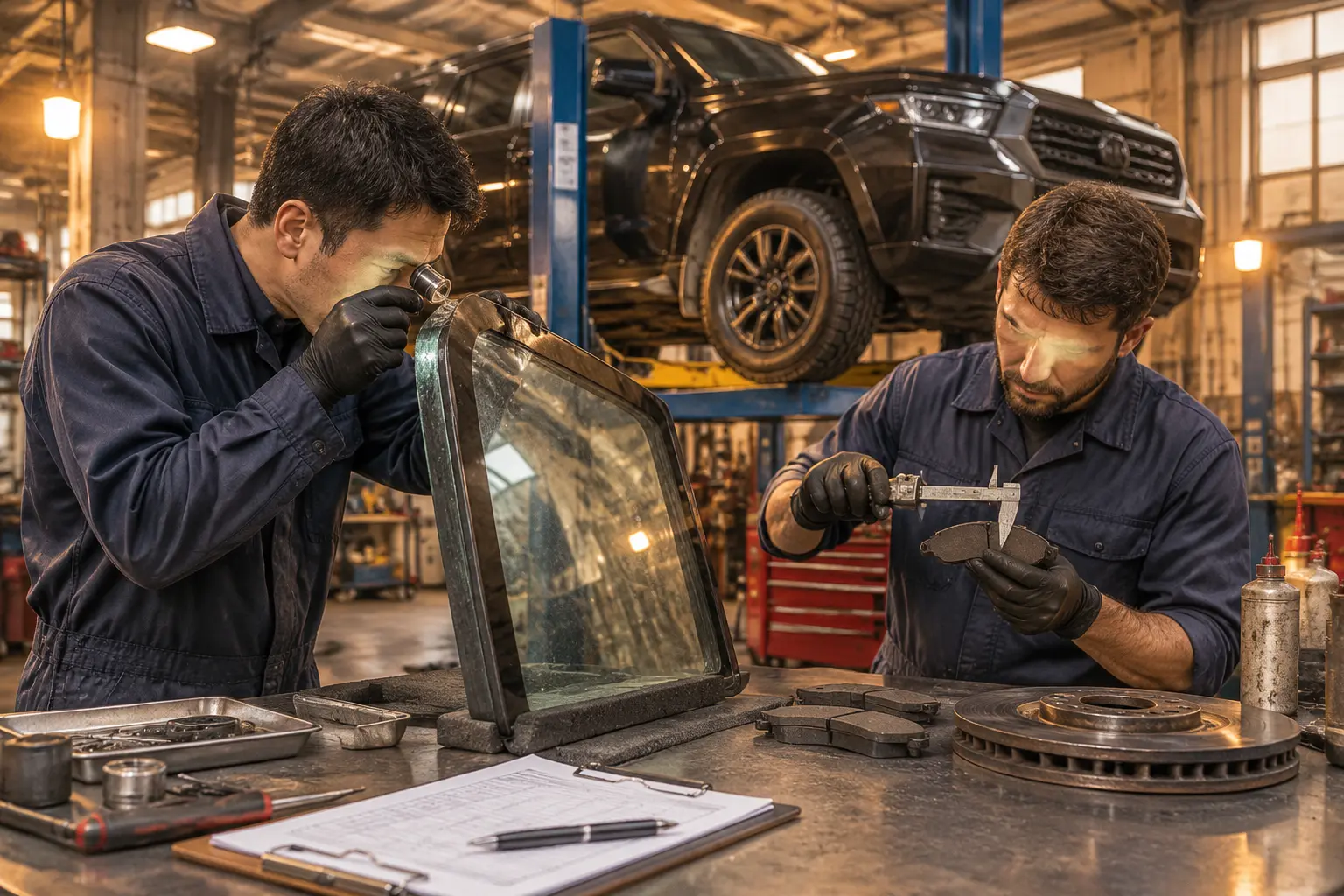
The secondary market for second hand armoured vehicles for sale often appears attractive because pre-owned inventory seems to offer immediate delivery at a substantial discount compared to new builds. However, acquiring used bulletproof cars for sale introduces severe physical, dynamic, and material risks absent from normal pre-owned vehicle purchases. Best Bulletproof Cars: How to Judge Protection Instead of Marketing
Vehicle Subsystem | Baseline Factory Wear | Armored Pre-Owned Vehicle Reality | Inspection Consequence |
|---|---|---|---|
Door Hinges & Pillars | Negligible play over 120,000 km | Hinge pin ovalization and A/B-pillar weld fatigue | Doors sag 3 mm to 6 mm; gaps break ballistic overlap seal |
Transparent Armor | Minor surface pitting from road debris | Edge delamination, moisture haze, PVB yellowing | Severe optical distortion; compromised multi-hit retention |
Suspension Geometry | Standard bushing replacement intervals | Crushed bump stops, cracked spring perches | Extreme dynamic roll, bottoming out over minor road hazards |
Braking Components | Routine friction lining wear | Rotor heat-checking, fluid boiling, pad glazing | Up to 35% longer stopping distances under emergency deceleration |
The Impact of Continuous Static Load
When an everyday civilian SUV carries an added metric ton of high-hardness armor steel (such as Ramor 500 or Armox 500T) along with thick composite window packs, its chassis, bushings, and wheel hubs operate under permanent mechanical compression.
In our direct engineering teardowns of decommissioned security fleet vehicles, factory-stamped door hinges on used B6-armored SUVs consistently show severe hinge-pin ovalization after 24 to 36 months of regular field service. With an armored front door assembly weighing between 95 kg and 135 kg, the continuous downward leverage deforms the door pillar mounting plates. This structural sag causes the door to drop by 3 mm to 6 mm, crushing weather seals, causing wind and water intrusion, and misaligning the critical steel ballistic overlaps designed to prevent bullet wash at oblique strike angles.
Transparent Armor Degradation Over Time
While high-hardness opaque armor plate retains its ballistic yield strength indefinitely barring physical corrosion or previous structural impact, vehicle ballistic glass exhibits a distinct operational lifespan. Automotive transparent armor is an engineered laminate consisting of float glass plies, chemically strengthened strike faces, elastomeric interlayers, and internal polycarbonate spall barriers. Bulletproof Vehicle Glass | BallisticBuddy Armored Vehicle Glass Structure Viewer — Free Interactive 3D Tool
In used armored cars for sale, especially those deployed in high-heat or high-humidity climates, the transparent armor often shows advanced edge delamination. Over three to six years, exposure to severe thermal cycling—such as 45 degrees Celsius ambient desert heat dropping rapidly under maximum interior air conditioning—creates severe differential expansion between the rigid glass plies and flexible polycarbonate liners. If the perimeter seal fails, ambient moisture penetrates the interlayers, creating a cloudy, milky perimeter that impairs driver visibility and weakens the multi-hit impact retention of the entire transparent composite.
What to Verify Before Paying for an Armored Vehicle
Entering a commercial transaction for a bulletproof car demands an exhaustive technical audit that goes well beyond verifying service history or bodywork condition.
1. Ballistic Certification and Traceable Batch Tags
Every legitimate up-armored vehicle must be accompanied by comprehensive ballistic test records corresponding directly to the installed materials. Test Results & Reports | BallisticBuddy
Inspect each transparent armor panel for permanent, embedded corner serial tags. These production tags must correlate with official laboratory reports issued by accredited proof houses—such as FDCL (First Division Testing / Security & Police Electronic Product Quality Testing) or European Beschussamt facilities operating under CEN EN 1063 or VPAM BRV standards. If a broker or seller cannot produce documentation connecting the specific glass serial numbers to an accredited testing facility, terminate the transaction. Counterfeit transparent armor and uncertified residential-grade laminates remain a major hazard in unmonitored pre-owned channels. Vehicle Shooting Protection: What to Do If Your Car Is Shot At
2. Certified Scale Weight vs Axle Ratings
Never rely on the manufacturer's nominal conversion estimates listed in sales brochures. Prior to releasing funds, mandate an official weighbridge ticket detailing:
- The exact unladen Gross Vehicle Mass (GVM).
- Independent wheel-load and axle-weight distributions across both front and rear axles.
If a converted SUV scales at 4,600 kg but retains OEM factory coil springs and stock single-piston floating brake calipers, the platform is mechanically hazardous. Comparing scaled weight against the vehicle's Gross Axle Weight Ratings (GAWR) clarifies whether the platform was fully re-engineered or simply overloaded.
3. Ballistic Overlap Construction and Door Seam Integrity
Examine the door frame apertures while all doors are fully closed and latched. A professionally converted platform incorporates 5.0 mm to 6.5 mm high-hardness steel overlap flanges welded to the door framework that extend over the vehicle pillars.
Verify that:
- The overlap flange overlaps the vehicle body structure by a minimum of 15 mm to 20 mm.
- Hinge pin drop has not created line-of-sight gaps where an incoming projectile fired at an angle could bypass the armor and enter the cabin.
- The return lip on the overlap flange contains a spall return channel designed to capture lead wash and bullet core splatter.
4. Running Gear: Brakes, Dampers, and Run-Flats
Audit the vehicle build records for mechanical upgrades capable of managing the platform's added kinetic energy:
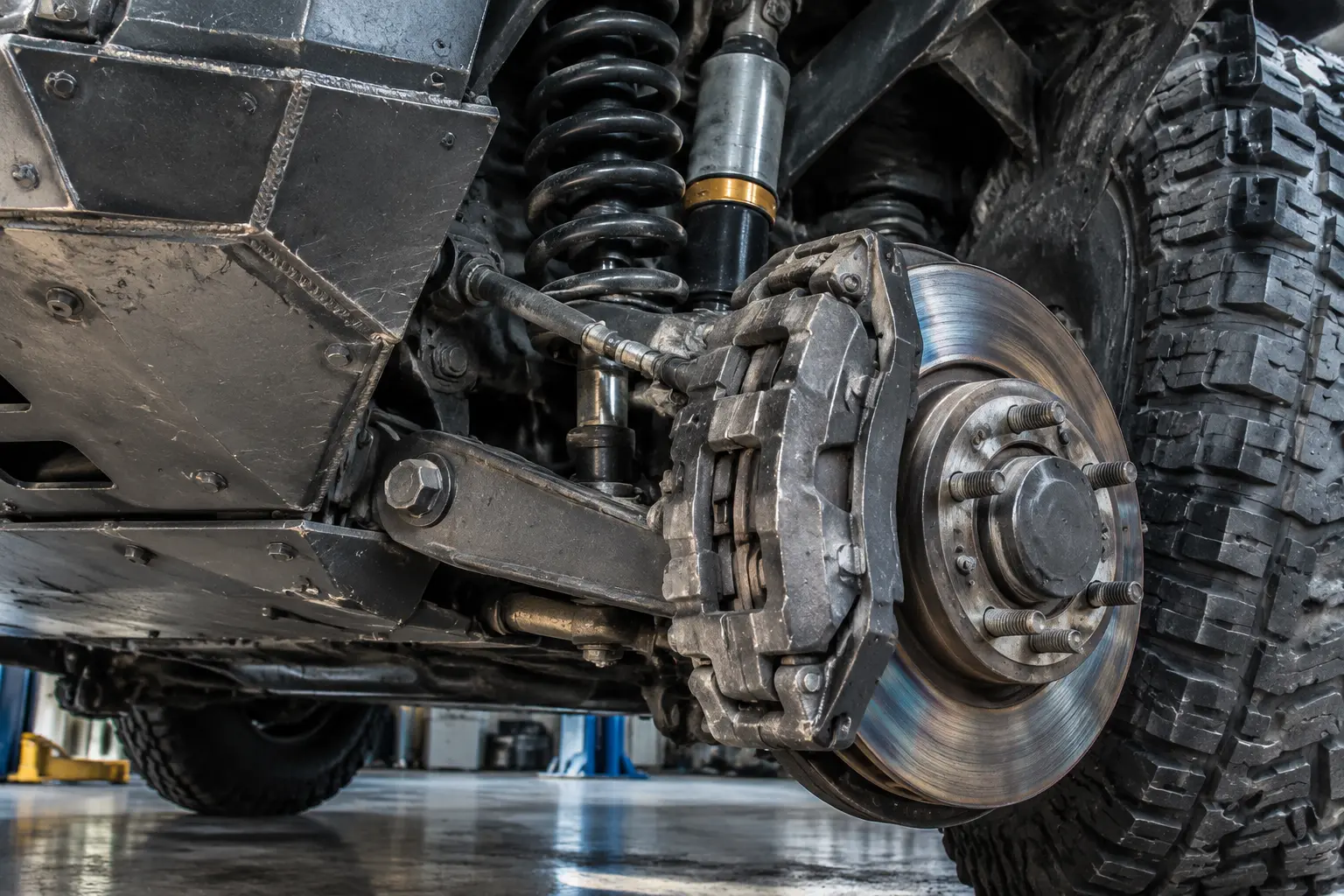
- Braking Systems: Factory brakes suffer rapid thermal fade when stopping a heavily armored SUV from highway speeds. The build must incorporate high-thermal-capacity slotted discs (380 mm or larger), multi-piston heavy-duty calipers, and high-temperature brake fluid.
- Suspension: Confirm the presence of high-rate progressive coil packs and high-volume monotube dampers with external oil reservoirs to control body pitch and dissipate fluid heat.
- Tire Inserts: Confirm that authentic, uncompromised run-flat assemblies are secured inside the wheel rims rather than standard commercial pneumatic tires.
Why Component Supply Often Beats a Finished Vehicle
For corporate risk managers, government entities, mining groups, and private fleet operators, procuring complete vehicles off secondary showroom floors is frequently less practical than establishing an ongoing component supply chain.
Procurement Consideration | Purchasing Pre-Owned Finished Stock | BallisticBuddy Component Supply Model | Operational Advantage |
|---|---|---|---|
Glass Quality | Unknown operational age; risk of hidden delamination | Brand-new autoclaved glass; CAD-modeled fit | Maximum optical clarity and zero-shear bonding integrity |
Rebate Fitment | Locked into the original builder's hand-cut frame | Precision-bent to exact OEM window flange contours | Eliminates uneven adhesive cross-sections and stress cracks |
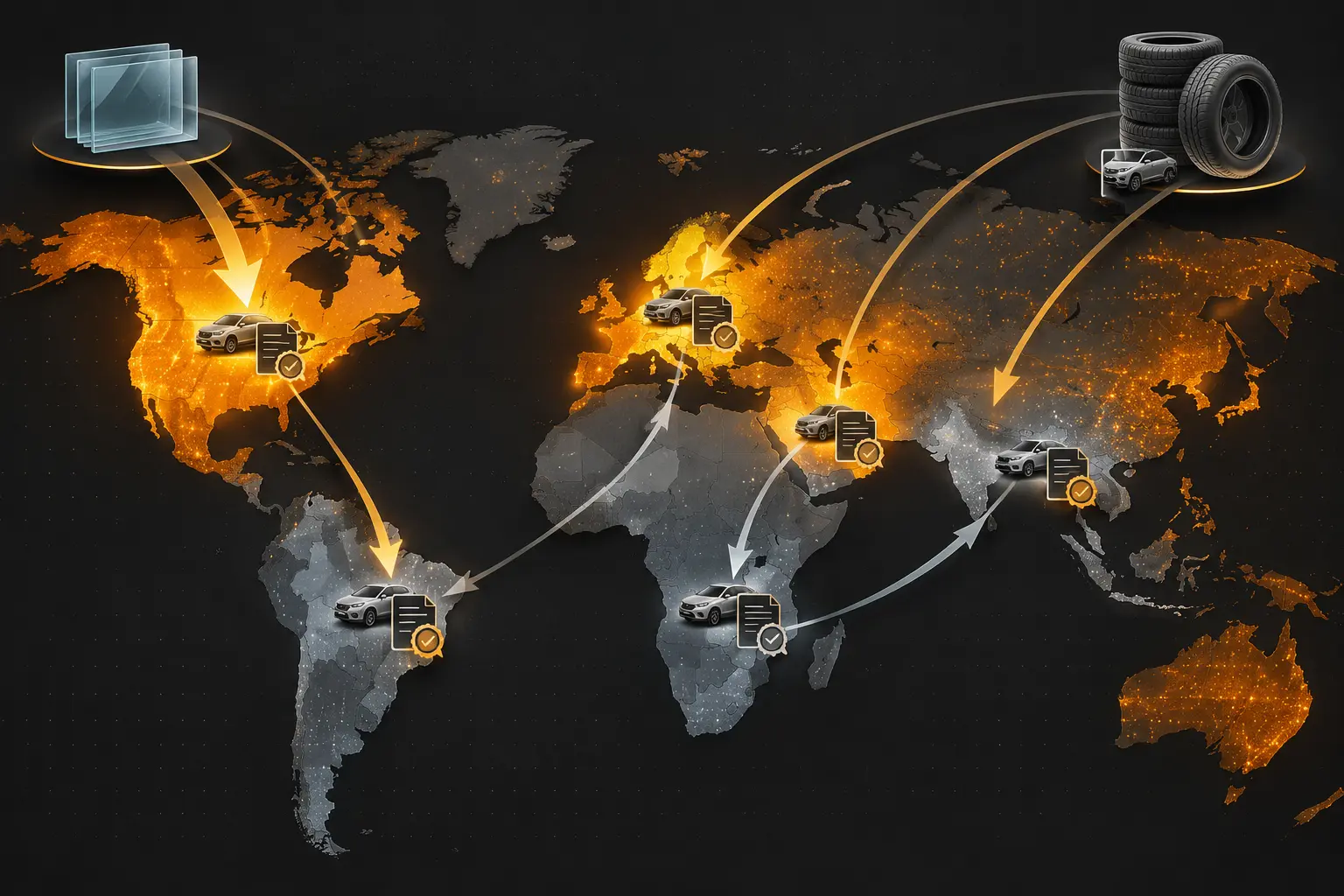
Freight & Shipping | Expensive Roll-on/Roll-off (Ro-Ro) vehicle transport | Compact, wooden-crate air and ocean freight | Substantially reduced logistics expenditures and transit timelines |
Import Tariffs | Elevated vehicle import tariffs and luxury taxes | Standard automotive replacement component tariffs | Bypasses restrictive whole-vehicle luxury import regulations |
Long-Term Spares | Difficult to locate custom-cut replacement glass | Direct re-order using standardized CAD serial numbers | Rapid dispatch of drop-in replacement panels during fleet maintenance |
Precision-Bent Ballistic Glass vs Hand-Cut Substitutes
A severe operational bottleneck in complete-vehicle acquisitions is the eventual requirement for glass replacement. When a curved ballistic windshield suffers severe rock pitting or begins to haze, sourcing a replacement panel that fits an obscure coachbuilder's custom-welded frame can take months or require extensive structural modification.
BallisticBuddy addresses this issue by manufacturing certified automotive ballistic glass designed from direct factory CAD scans. Whether delivering compound-curved windshields for the Land Cruiser 300 series, flat laminated side panels for light utility vehicles, or bespoke multi-ply composite stacks, our production tolerances maintain window rebate deviations below 0.5 mm. This tight tolerance guarantees uniform polyurethane adhesive thickness, preventing the localized shear forces that lead to early edge delamination. Armored Toyota Land Cruiser: Glass, Armor, and What Changes
Standardized Heavy-Duty Run-Flat assemblies
Operating an armored convoy across austere environments demands standardized, field-serviceable run-flat systems. If an armored vehicle for sale arrives with obsolete or proprietary run-flats requiring custom hydraulic mounting machines, a flat tire in a remote area can leave the vehicle immobile.
BallisticBuddy supplies two-piece and split-ring elastomeric and composite run-flat wheel inserts built to FINABEL A.20.A standards. These inserts provide up to 50 kilometers of operational mobility at 50 km/h following catastrophic tire pressure loss, and they can be mounted and dismounted using standard workshop equipment. Free Vehicle Armor Tools — Interactive 3D Viewers & Calculators
Test Samples and Material Validation
For organizations coordinating multi-chassis armoring programs or defense up-fitters preparing competitive tenders, independent ballistic validation prior to contract signing is mandatory. Order a Test Sample | BallisticBuddy
BallisticBuddy supports professional coachbuilders and fleet directors by supplying certified ballistic coupon specimens, full-scale test samples, and authenticated proof-house firing test reports covering CEN BR4, BR5, BR6, and VPAM VR7 standards. Procuring certified components directly gives buyers complete control over their supply chain and ensures their fleet meets strict technical specifications.
Regional Availability and Procurement Dynamics
Navigating the international market for bulletproof cars for sale requires evaluating how local security challenges, automotive import duties, and national arms control regulations govern supply. Is It Legal to Bulletproof a Car? Rules by Country
Geographic Market | Primary Operational Requirement | Favored Vehicle Platforms | Dominant Regulatory / Market Barrier |
|---|---|---|---|
South Africa | Anti-carjacking defense, B4 and B6 protection | Toyota Land Cruiser, Hilux, Fortuner, Ford Ranger | Road Traffic Act tare updates; DCAC defense manufacturer tracking |
Latin America | Urban kidnapping defense, B4 and B5 handguns | Toyota Prado, Fortuner, Jeep Grand Cherokee | Regional armor registries; strict visible light transmission rules |
Middle East / GCC | High-threat VIP convoys, VR7 and B6 rifle defense | Toyota Land Cruiser 300, Nissan Patrol, Lexus LX600 | Ministry of Interior security vetting; mandatory armored registration |
North America | Executive protection, discrete low-profile transit | Chevrolet Suburban, Cadillac Escalade, GMC Yukon | DOT FMVSS optical compliance; federal ITAR/EAR export regulations |
South Africa: The Benchmark for Utility Armoring
South Africa represents one of the most mature commercial markets for civilian armored vehicles in the world. High rates of violent armed carjackings, cash-in-transit ambushes, and kidnapping have established strong civilian demand for both B4 handgun protection and B6 assault rifle defense. Carjacking Prevention: How to Avoid It and What to Do If It Happens Hijacking Protection: How Vehicle Specification Changes the Outcome
In the regional market for a bulletproof car South Africa or when evaluating a B6 armoured vehicle for sale South Africa, transactions focus primarily on light commercial bakkies and rugged ladder-frame chassis. The Toyota Hilux, Fortuner, and Land Cruiser 70 and 300 series dominate private and commercial fleets. Armoured Toyota Hilux: Workhorse Armoring in South Africa Armoured Toyota Fortuner: Protection for a Popular SUV
However, prospective buyers must confirm that any second hand armoured vehicles for sale have had their updated tare mass officially certified on the national NaTIS vehicle register. Equipping a chassis with 800 kg of B6 ballistic steel and glass without updating the unladen mass on the registration documentation invalidates the vehicle's roadworthy certification, allowing insurance providers to reject accident claims automatically.
Latin America and the Caribbean Basin
Across urban centers in Brazil, Mexico, and Colombia, the private market favors discreet, low-profile passenger vehicles. Level CEN BR4 (defeating .44 Magnum and 9mm submachine fire using 21 mm to 26 mm glass) represents a major segment of consumer transactions due to its manageable mass addition (250 kg to 350 kg), which preserves OEM handling, acceleration, and fuel consumption in congested city driving.
When auditing pre-owned vehicles in these jurisdictions, verifying that the transparent armor maintains minimum 70% visible light transmission (VLT) is vital. Widespread use of sub-tier adhesive films in unaccredited conversion facilities frequently causes rapid interlayer yellowing and optical distortion under strong equatorial sunlight.
Middle East and the GCC Nations
The Gulf Cooperation Council (GCC) market—led by the United Arab Emirates and Saudi Arabia—focuses heavily on high-energy rifle defense, with CEN BR6, BR7, and VPAM VR7 being standard. The dominant platforms are the Toyota Land Cruiser 300 and the Nissan Patrol Y62. VIP Vehicle Protection: What Executive Travel Actually Requires
Purchasing an armored vehicle in this region requires official government pre-clearance. Clients cannot simply take delivery of a B6 vehicle without formal security authorization from regional authorities (such as the Ministry of Interior or Dubai Police GHQ). Component traceability is strictly enforced, requiring all imported ballistic glass and run-flat rings to clear customs with verified proof-house certificates.
Technical Observations from Field Engineering
When evaluating an armored conversion for operational deployment, superficial cosmetic inspections are insufficient. Over hundreds of vehicle teardowns, our engineering teams have observed that functional failures frequently originate from mechanical oversights rather than overt ballistic flaws.
In one multi-vehicle fleet teardown involving heavy assault-rifle-rated SUVs deployed in demanding operational environments, our team observed that door hinge pins on stock stamped hinges ovalized by up to 4.2 mm after just 14,000 kilometers of mixed-road use. This drop caused the upper steel ballistic overlaps to misalign by over 8 mm, breaking the overlap protection boundary. From a regulatory and safety perspective, the vehicle no longer provided the certified ballistic envelope specified in its homologation file, and the door sag prevented the latches from clearing emergency egress release standards during annual safety testing.
Similarly, thermal shock remains a major driver of transparent armor degradation. When 40 mm curved ballistic windshields are bonded into vehicle frames using improper rebate tolerances, minor frame flex places immense physical shear on the glass plies. In high-ambient environments where exterior temperatures exceed 45 degrees Celsius while interior air conditioning maintains 20 degrees Celsius, this thermal gradient accelerates edge delamination. Within 18 months, the outer margins cloud, obscuring the driver's peripheral field of view below the mandatory 70% light transmission threshold required by transport authorities.
Ballistic Protection Level Reference for Vehicle Procurement
Ballistic Standard | Projectile Profile | Striking Velocity | Glass Thickness Range | Typical Added Armor Weight | Target Threat Environment |
|---|---|---|---|---|---|
CEN BR4 / FB4 | .44 Rem Magnum SJHP | 440 ± 10 m/s | 21 mm to 26 mm | +250 kg to 350 kg | Handguns, opportunistic street crime |
CEN BR5 / FB5 | 5.56x45mm NATO (SS109) | 950 ± 10 m/s | 36 mm to 40 mm | +550 kg to 750 kg | High-velocity carbines, light rifles |
CEN BR6 / FB6 | 7.62x51mm NATO (M80 Ball) | 830 ± 10 m/s | 38 mm to 43 mm | +800 kg to 1,300 kg | Global baseline for assault rifle defense |
VPAM VR7 / VR9 | 7.62x51mm AP / Hard Core | High Velocity | 48 mm to 65 mm | +1,200 kg to 2,000 kg | High-threat convoys, tactical extractions |
Frequently Asked Questions
Where can a civilian legally buy a bulletproof car?
In most democratic nations—including the United States, Canada, the United Kingdom, European Union member states, and South Africa—civilians can legally buy a bulletproof car directly from certified vehicle up-fitters, specialty brokers, or pre-owned inventory dealers. Specific jurisdictions, such as British Columbia in Canada or member states of the Gulf Cooperation Council (GCC), require owners to obtain background checks or security permits prior to purchase.
Are used armored cars safe to buy?
A used armored car is only as safe as its maintenance history and the physical condition of its ballistic materials. While high-hardness armor steel plating does not degrade over time, transparent armor (ballistic glass) suffers from thermal stress, edge delamination, and UV degradation, which can compromise multi-hit protection. Additionally, the continuous load of 800 kg to 1,200 kg of static armor accelerates wear on factory door hinges, suspension coils, wheel bearings, and braking systems. Any used armored vehicle must undergo an extensive technical audit before purchase.
How much does an armored car cost?
Total acquisition costs depend heavily on whether the vehicle is purchased new, used, or commissioned as a custom up-fit. On the pre-owned market, older handgun-protected (BR4) SUVs can be found starting around thirty to fifty thousand dollars, while late-model assault rifle-protected (BR6) SUVs generally sell between ninety thousand and two hundred thousand dollars. Brand-new, factory-certified BR6 or VR7 luxury conversions (such as an up-armored LC300 or Mercedes G63) typically range from two hundred thousand to well over four hundred and fifty thousand dollars, depending on chassis specification, bespoke interior appointments, and mechanical enhancements. How Much Does It Cost to Bulletproof a Car?
Which ballistic level is most common for civilian armored cars?
For personal security and anti-kidnapping protection in urban environments, CEN BR4 (handgun defense using 21 mm to 26 mm glass) is widely selected because it adds minimal weight (250 kg to 350 kg) while stopping common pistol threats like 9mm and .44 Magnum. For corporate, diplomatic, and high-threat transport, CEN BR6 (assault rifle protection using 38 mm to 43 mm glass) is the global benchmark, engineered to defeat 7.62x51mm NATO and 7.62x39mm AK-47 rounds. How to Protect Your Vehicle: A Threat-Based Approach
Can an armored car be serviced at a regular automotive dealership?
Routine powertrain maintenance—such as engine oil changes, spark plug replacements, and routine filter changes—can typically be performed by standard commercial automotive dealerships. However, suspension alignments, brake overhauls, door hinge adjustments, and transparent armor replacements require specialized workshops experienced in heavy up-armored vehicles. Standard dealership lifts and tire machines are often unequipped to handle 4.5-ton curb weights or multi-piece run-flat wheel assemblies.
What causes ballistic glass to delaminate on older vehicles?
Delamination occurs when synthetic bonding interlayers (polyvinyl butyral or thermoplastic polyurethane) separate from the glass plies or interior polycarbonate substrate. This failure is accelerated by extreme thermal fluctuations, exposure to direct sunlight, poor edge-seal craftsmanship, and high-pressure chemical washings. Once the airtight seal fails, moisture penetrates the laminate stack, causing milkiness, visual distortion, and reduced multi-hit ballistic integrity.
Does BallisticBuddy sell complete armored vehicles?
No. BallisticBuddy is an engineering component manufacturer, not a whole-vehicle armoring facility. We design, produce, and distribute certified automotive ballistic glass, curved replacement windshields, and heavy-duty run-flat systems directly to professional armoring coachbuilders, fleet management companies, and specialized defense up-fitters globally. Contact Us — Quotes & Test Samples | BallisticBuddy
How do run-flat systems work when a tire is shot out?
When a pneumatic tire loses pressure due to ballistic puncture or sidewall blowouts, the tire casing collapses directly onto a solid composite or elastomeric run-flat ring locked around the center of the wheel rim. This ring supports the vehicle's weight and prevents the rubber tire from shredding or separating from the wheel. High-grade systems compliant with FINABEL A.20.A standards allow the driver to maintain steering control and travel up to 50 kilometers at 50 km/h to escape an ambush zone.
Sources
- European Committee for Standardization: CEN EN 1063: Glass in Building – Security Glazing – Testing and Classification of Resistance Against Bullet Attack.
- FINABEL: Agreement A.20.A: Pneumatic Tyres and Wheel Assemblies for Special Combat and Logistics Vehicles.
- Republic of South Africa: National Road Traffic Act, No. 93 of 1996 and NaTIS Vehicle Regulations.
- SSAB High-Strength Steels: Armox 500T / Ramor 500 High-Hardness Protection Steels Technical Data.
- Beschussamt Mellrichstadt: VPAM BRV 2009 Guidelines for Bullet Resistant Vehicles.
- National Highway Traffic Safety Administration (NHTSA): Federal Motor Vehicle Safety Standard 205 (FMVSS 205) – Glazing Materials.